


.jpg)



Most people have to take out a loan or rely on credit at least once in their lives. For many, taking on debt is a necessary part of buying a house, leasing a vehicle, or going to school.
Debt taken out for personal reasons is known as “consumer debt,” and it’s evolved in surprising ways over the years. Here’s a closer look at consumer debt in the U.S. by decade.
Consumer debt in the U.S. by decade
| Decade | Total Consumer Debt | Primary Debt Types | Key Context |
|---|---|---|---|
| 1950s | ~$56 billion | Auto loans, installment credit | Post-war consumer boom; credit cards not yet widely available |
| 1960s | ~$127 billion | Auto loans, installment credit, early charge cards | BankAmericard (Visa) launched 1958; revolving credit begins growing |
| 1970s | ~$350 billion | Auto loans, revolving credit, mortgages | Credit card adoption accelerates; state usury caps keep rates near 18% |
| 1980s | ~$798 billion | Mortgages, credit cards, auto loans | Deregulation removes rate caps; credit card balances quadruple |
| 1990s | ~$1.54 trillion | Mortgages, credit cards, student loans, auto loans | Mass credit card issuance; student loan debt begins its long rise |
| 2000s | ~$2.54 trillion | Mortgages, credit cards, student loans, auto loans | Housing bubble drives mortgage surge; financial crisis triggers deleveraging |
| 2010s | ~$4.17 trillion | Mortgages, student loans, auto loans, credit cards | Student loan debt surpasses $1 trillion; auto lending reaches record highs |
| 2020s | ~$5.1 trillion | Mortgages, credit cards, student loans, auto loans | Pandemic briefly cuts balances; inflation drives credit card debt to record $1.27T by 2025 |
How consumer debt is measured and categorized
Consumer debt includes many types of credit taken out for personal or household (not business) reasons. A few examples include:
- Auto loans
- Mortgages
- Student loans
- Personal loans
- Credit cards
Broadly speaking, consumer debt can be divided into two categories:
- Installment Loans: Lump sums that are borrowed and repaid
- Revolving Credit: Credit lines that can be repeatedly borrowed against and repaid
Consumer debt can also be secured or unsecured. Secured debt is backed by an asset (like a car or a home) that the lender can seize if the borrower defaults. Unsecured debt isn’t backed by anything, presenting more risk for the lender.
How the Federal Reserve tracks consumer debt
The Federal Reserve (often referred to simply as “the Fed”) tracks consumer debt using anonymized samples of credit report data from Equifax. It examines data from 5% of the population with a credit report.[1] That information provides the basis for the New York Fed Consumer Credit Panel (CCP), an extensive dataset that informs a number of research and policy decisions.
When the Fed compiles the CCP, it often divides consumer debt into housing debt and non-housing debt. It reports specific figures for most major types of household credit, including:
- Mortgages and home equity lines of credit (HELOCs)
- Auto loans
- Student loans
- Credit cards
Personal loans and other kinds of consumer debt that don’t fit into one of these categories are generally lumped into the “other” category.
Consumer debt by decade: A historical breakdown
In the distant past, consumer debt was considered to be a taboo or a moral failing. Today, it’s commonplace. Here’s a look at consumer debt in the U.S. by decade to provide some context for how things got the way they are today.
The 1950s and 1960s: Installment credit and the postwar consumer economy
After World War II, the U.S. saw major cultural shifts in how consumer spending was viewed.
After years of economic depression, the postwar economy needed mass consumption to thrive, and Americans were happy to oblige.[2] Instead of being seen as financially risky, consumption became patriotic. By buying homes, cars, and appliances, Americans were doing their part to help the country recover.
During this time, the idea of revolving credit was still fairly new. The first modern credit card, the Diners Club card, was released in 1950. Mortgage loans, car loans, and other kinds of installment loans saw a surge in popularity too. During the postwar period, about 50% of families held some kind of installment debt.[3]
This was also a time when the types of credit Americans used were undergoing a major change. Some older types of credit, such as pawning, became less popular. They were replaced by a wave of new kinds of unsecured debt (both installment and revolving), which included:[3]
- Student loans
- Payday loans
- Credit cards
- Bank lines of credit
In the 1950s and 1960s, consumers didn’t just have more credit options to choose from. They were also experiencing a cultural shift where taking on debt was routine. That shift was a pivotal point in U.S. household debt history: It established the foundation for steadily growing consumer debt.
The 1970s: Inflation, deregulation, and rising household borrowing
During the 1970s (more specifically, from 1965 to 1982), the United States experienced what’s sometimes referred to as the “Great Inflation.” The economy saw an astounding 14% inflation rate.[4]
The Great Inflation was also a time of economic stagnation, subjecting consumers to what we now call “stagflation.”
Thanks to the 1973 OPEC oil embargo, oil prices jumped 350%, which drove prices higher.[5] The Federal Reserve aggressively raised rates to curb inflation during this time, but that made mortgages, auto loans, and other kinds of consumer debt much more expensive.
Higher prices weren’t the only thing straining consumers’ wallets. In 1978, a landmark Supreme Court decision permitted banks to charge consumers credit card interest rates based on where the bank was registered, not where the consumer lived.[6] This new decision effectively made state-level usury laws (which capped credit card interest rates) obsolete.
With higher interest rates becoming normal across the board, consumer debt grew faster. Inflation and surging prices made it harder for Americans to make ends meet, so many increasingly relied on credit cards and other kinds of debt to get by.
The 1980s: Credit card expansion and the beginning of revolving debt culture
Although credit cards date back to the 1950s, they didn’t gain widespread popularity until the 1980s. From 1983 to 2008, the total number of credit cards in circulation saw a twentyfold increase.[7]
Why the explosion? The 1980s were a unique time, and a multitude of factors came together to create what’s sometimes called “revolving debt culture”:
- Credit card companies launched massive marketing campaigns and sent out millions of pre-approved card offers
- As stagflation persisted and consumers’ real wages decreased, credit cards helped fill income gaps
- Credit card companies began lowering minimum payment amounts, which encouraged users to carry balances from one month to the next[8]
Some people leaned on credit cards out of necessity. However, in the 1980s, there was a distinct cultural shift to a “charge it” mindset. For many consumers, putting something on a credit card and carrying the balance from month to month became normal.
Thanks to the combination of higher interest rates and more consumers carrying balances, credit card companies’ profits soared — and so did outstanding consumer debt.
The 1990s: Economic growth and accelerating debt loads
Many historians characterize the 1990s as a time of economic prosperity. However, some economic researchers have pointed out that the significant consumption growth seen in this period was driven in part by increasing consumer debt.[9]
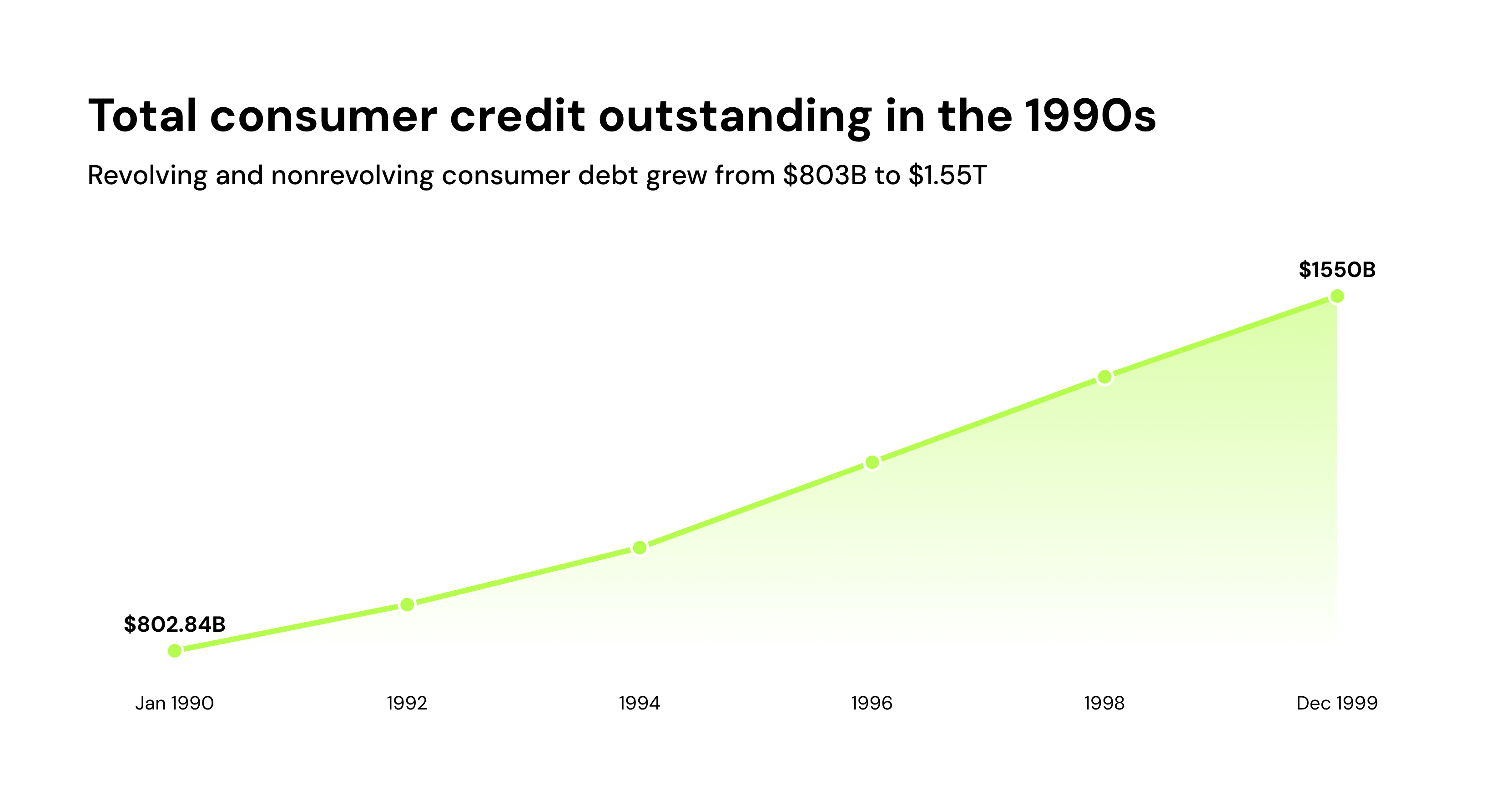
The Federal Reserve’s record of total consumer credit outstanding may give you an idea of how much consumer debt increased over this decade. In January 1990, total consumer debt (revolving and non-revolving) was $802.84 billion. By December 1999, it had reached $1.55 trillion.[10]
However, the increase in the raw numbers isn’t the only thing that matters here. In the 1990s, debt-service burdens (the share of a consumer’s income that goes toward servicing debt) reached an all-time high.[9]
High debt-service burdens place consumers at greater risk of default. As is now clear, the debt growth of the 1990s helped set the stage for the financial crisis of the 2000s.
The 2000s: The mortgage boom and peak household leverage
Before the housing bubble burst, the 2000s were a time of low-interest mortgages. Lending standards were relaxed (at least by today’s standards), and for the first time, it became easy for those with below-average credit to get a mortgage.[11]
Total mortgage debt grew significantly, even in the few years leading up to the crisis. In the first quarter of 2002, housing debt stood at $6.17 trillion. By the third quarter of 2008, it was $9.99 trillion.[12]
Consumers were overleveraged, and lenders had bundled many of these subprime loans into securities that they assured investors were “safe.” Home prices started to plummet in 2006, and subprime borrowers who couldn’t afford their mortgage payments were unable to refinance because their homes were worth much less than their mortgages.
The 2010s: Post-crisis deleveraging and the student loan surge
The 2010s saw major decreases in mortgage debt. In the fourth quarter of 2008, non-housing debt was $2.71 trillion, and housing debt was $9.96 trillion. By the second quarter of 2013, non-housing debt had marginally increased to $2.77 trillion, but mortgage debt had fallen to $8.38 trillion.[12]
However, another kind of consumer debt was growing much faster than the rest. As the increasing costs of college tuition outpaced inflation, many consumers were taking on sizable student loan debt.
In the first quarter of 2010, student loan debt was at $760 billion. By the first quarter of 2015, it had reached $1.19 trillion. And by the first quarter of 2020, it was $1.53 trillion.[12]
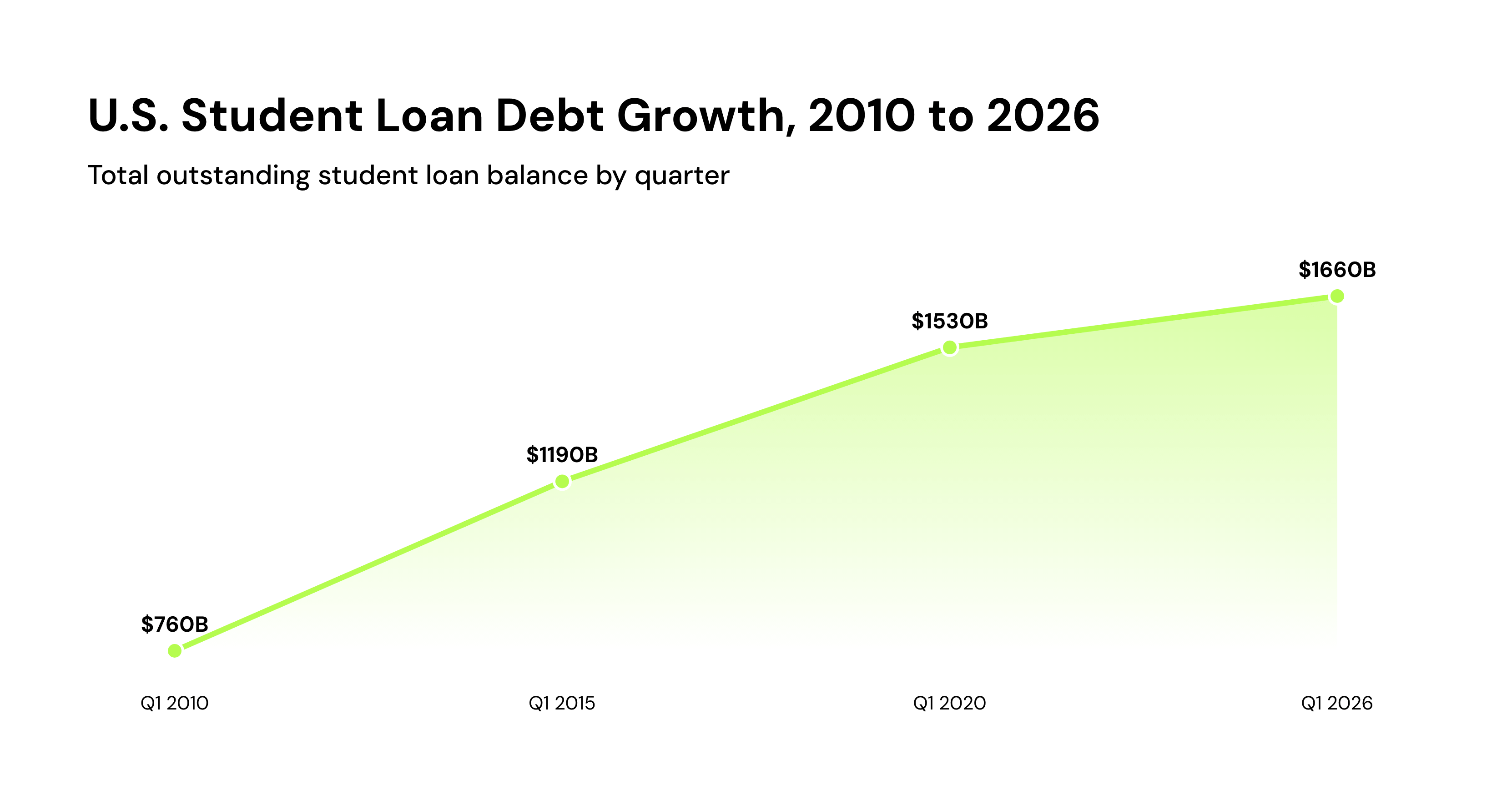
Student loan debt has continued to climb into the 2020s as well. In the first quarter of 2026, it was calculated at $1.66 trillion.[12]
The 2020s: Pandemic paydowns, record credit card balances, and rising auto debt
The early 2020s saw the COVID-19 pandemic disrupt economies on a global scale. But for some consumers, the pandemic was a time to pay down debt and improve their credit scores. During this period, the proportion of people with a “good” or better credit score increased considerably.[13]
Because many businesses were closed during the pandemic, consumers generally faced less pressure to spend. Many who received economic stimulus checks used them to pay down existing debt.
However, this relatively minor deleveraging would be short-lived. The post-pandemic consumer economy shares some similarities with the stagflation of the 1970s and early 1980s. Price surges and stagnating wages have forced many consumers to turn to credit cards to bridge shortfalls and cover daily expenses.
In 2023, the total consumer credit card debt crossed the trillion-dollar threshold for the first time, and it has only trended upward since then. By the first quarter of 2026, credit card debt was at $1.25 trillion.[12]
Unfortunately, student loan debt and credit card debt aren’t the only types of debt to increase. Rising vehicle prices and high interest rates have contributed to an increase in overall auto debt too.
In the first quarter of 2020, total auto loan debt was $1.35 trillion. By the first quarter of 2026, it was $1.69 trillion.[12]
The composition of consumer debt over time
Through the decades, the various types of consumer debt have all followed a general upward trend. However, unique economic pressures mean that during certain time periods, some kinds of debt are more heavily influenced than others.
How the mix of mortgage, credit card, auto, and student debt has shifted
Historically, mortgage debt has made up the largest share of consumer debt. In the first quarter of 2026, outstanding housing debt was at $13.6 trillion.[12] The growth of that debt figure isn’t likely to change anytime soon. Mortgage rates remain high, and housing prices are elevated.
In two decades, student loan debt has more than doubled, and the total outstanding is more than Americans owe on credit cards and auto loans.[14]
Auto loan growth and the lengthening of loan terms
Auto loan debt has been steadily rising for years. While the increase hasn’t been as sharp as that of credit card or student loan debt, it still represents a serious concern for many Americans, and especially for subprime borrowers.
Between high interest rates and record vehicle prices, many borrowers struggle to afford cars. Auto lenders discovered that by lengthening loan terms (and therefore offering lower monthly payments), they could continue to sell vehicles despite the obvious affordability issue.
Having lower monthly payments may reduce short-term stress for buyers. The downside is that longer loan terms mean they pay more in interest over time and drive up the country’s total auto loan debt.
What drives consumer debt growth?
For decades, many people have simply accepted that consumer debt was going to keep growing. And while it’s true that there’s been fluctuation, each type of consumer debt has generally trended upward. Why?
As this review of consumer debt in the U.S. by decade has shown, several key factors continue to drive consumer debt growth across generations.
Wage stagnation and the gap between income and cost of living
This is one of the most important factors to consider, especially as it relates to current debt.
It’s easy to look at increases in consumer debt and assume that it’s just the result of careless spending. However, when you consider the combination of slow or nonexistent wage growth with unprecedented increases in the cost of living, it’s easy to understand why many people rely more on consumer debt.
Since 2019, the cost of living has increased by more than 30%.[15] In many areas, the cost of housing, groceries, and other essentials has climbed even more. When consumers struggle to cover the rising costs of essentials, they often deplete their savings, turn to credit cards or personal loans to fill in the gaps, or both.
Interest rate environments and their effect on borrowing behavior
The Fed has the authority to adjust interest rates to curb inflation. Sometimes, higher rates dissuade people from borrowing, but that’s not always the case. For example, if you need to buy a car to get to work, you might not have the luxury of waiting for interest rates to go down before you do so.
Interest rates can drastically increase the cost of borrowing money, especially when you’re financing something as big as a house, a vehicle, or a college education.
Marketing, credit availability, and the normalization of carrying debt
As noted, credit is more accessible now than it has historically been. Prior to the 1950s, many people saw having consumer debt as something to be ashamed of (or at least not openly admit). But as credit cards and installment loans became widely available, having debt started to seem like something entirely normal.
Even today, that mindset may be partially responsible for increases in consumer debt. It’s easy to feel stressed, overwhelmed, and even ashamed by debt. However, when you see that you’re far from alone, taking on new debt might not seem like something you need to avoid if it’s necessary in your current situation.
FAQ
What is the total U.S. consumer debt?
As of the first quarter of 2026, U.S. household debt is at $18.8 trillion.[12]
Why does consumer debt keep going up?
There are many contributing factors to rising consumer debt. Rapid increases in the cost of living, persistent inflation, and high interest rates are three of the most critical.
Why does the Federal Reserve track consumer debt?
The Federal Reserve tracks consumer debt so it can stay informed about trends and risks in the banking system. The data it compiles helps it to make informed decisions about interest rate hikes and U.S. monetary policy.
American consumer debt over time: Why does it matter?
When you take the time to learn about consumer debt in the U.S. by decade, you’re doing more than just discovering interesting facts. Debt trends offer unique insights into the history of the economy from the perspective of the consumer.
If you’re struggling with debt yourself, learning about historical debt trends may be surprisingly helpful. As you’ve seen, struggles with debt are far from uncommon, and debt is often shaped by larger economic forces. In that sense, consumer debt is far more than just a personal problem.
Frequently Asked Questions
About the editor

Article Sources
Disclaimer: The information provided in this blog post is meant for informational purposes only and does not constitute financial advice.