


Cash-out refinance rates run higher than traditional refinancing, where you don’t take cash out, but the gap is usually under half a point. How much you pay depends on your credit score and how much equity, or the part of your home you own outright, you leave behind. And you can work on both before you apply.
How much higher are cash-out refinance rates?
Between 2013 and 2023, the median rate on a cash-out refinance was 3.62%, according to the Consumer Financial Protection Bureau, compared with 3.38% for refinances without cash out. That’s about a quarter of a point apart.
Cash-out borrowers in that data had lower credit scores to begin with (a median 741 versus 765), and cash-out refinancing is common when rates are rising. Some of that gap can be explained by who borrowed and when. But a 24-point difference in credit score doesn’t explain a quarter point on its own. That comes down to pricing.
Your own gap could be wider or narrower, because lenders don't price a cash-out refinance off a single number. Fannie Mae, which buys most conventional mortgages, charges the lender an extra fee on every cash-out refinance, and that fee climbs depending on how far your credit score sits below the top tier and how much of your home's value the new loan covers. Your lender passes it on either as points at closing or folded into the rate.
When comparing offers, ask every lender to quote you the rate and the points. A loan that looks cheap on one can be expensive on the other.
Read more >> What Is a Cash-Out Refinance?
Why cash-out refinance rates can be higher
With a cash-out refinance, you take out a new, larger mortgage, pay off the old one, and keep the extra as cash. Lenders may price that loan higher than traditional refinancing. The reasons for this include:
Increased lender risk
A cash-out refinance leaves the lender holding a bigger loan against the same house.
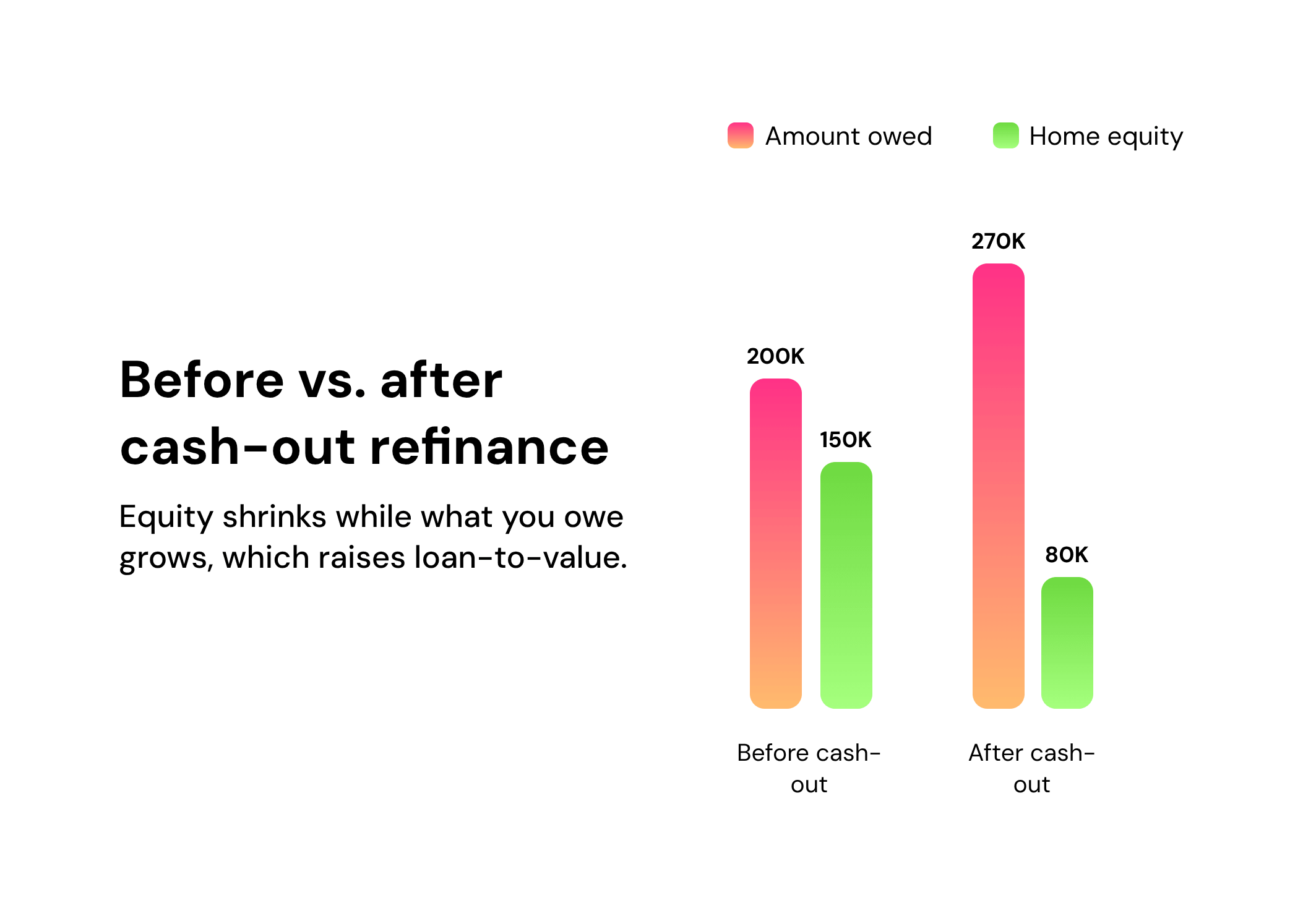
Say you owe $200,000 on a house worth $350,000. That leaves $150,000 in equity. But if you take $70,000 cash out, you now owe $270,000, leaving only $80,000 in equity. This makes it harder for the lender to get all their money back if something goes wrong and they have to sell the home.
For the owner, a bigger loan means a bigger payment, and a mortgage you can’t pay risks losing your home to foreclosure.
You do get three business days after signing to cancel. The CFPB calls this the right of rescission, and it applies to most mortgages you didn’t take out to buy the home, including cash-out refinancing.
Loan-to-value ratio
Lenders put a number on the risk described above. It’s called the loan-to-value ratio, or LTV, which is what you owe on your home divided by what your home is worth.
In that same example above, you started at 57% LTV ($200,000 ÷ $350,000). After the cash-out, you're at 77% LTV ($270,000 ÷ $350,000). This higher LTV represents the lender’s risk, and higher risk generally translates into a higher rate.
Read more >> Cash-Out Refinance vs. Home Equity Loan: What's the Difference?
Factors that affect your cash-out refinance rate
Here’s a quick look at the factors that can affect the rate you’re offered:
Refinancing because you can't keep up? Fall behind on unsecured debt and you damage your credit, and a creditor can sue you for it. Fall behind on the same debt once it's inside your mortgage and you can lose the house to foreclosure. It’s the trade a cash-out refinance makes for the life of the new loan.
Find out what else is on the table first. The NFCC can connect you to free or low-cost counseling at 800-388-2227. If you're already behind on the mortgage, a HUD-approved housing counselor can work with your servicer at 800-569-4287. Foreclosure counseling is free.
How to get a low cash-out refinance rate
- Compare at least four lenders. Today’s averages are roughly where they were in late 2022, when Freddie Mac estimated that two quotes would have saved a borrower as much as $600 a year, and four or more over $1,200. Mortgage inquiries made within 14 to 45 days count as one for most credit scoring models.
- Borrow only what you need. Every dollar you don't take keeps your LTV lower. If you can get by with $30,000 instead of $80,000, it's worth running the numbers on both to see how it impacts your rate.
- Ask about a shorter term. If you can afford higher monthly payments, 15-year fixed rates tend to be cheaper than 30-year rates and could save you thousands in interest over the long term.
- Give your credit time. If you're several months out from applying, that gives you time to pay down credit balances, increase your home’s equity, and build a positive payment history before a lender pulls your report.
Read more >> Are Home Equity Loan Interest Payments Tax-Deductible?
Bottom line
Cash-out refinance rates may be higher than traditional refinance rates, but the gap can be small. Before you commit, compare a cash-out refinance and a home equity loan to see how rates and fees compare.
Whichever type of loan you choose, your credit history plays a big role in the rate you're offered. Kikoff's Credit Account reports your on-time payments to all three credit bureaus, with no credit check to join. Plans start at $5 a month.
Frequently Asked Questions
Article Sources
Disclaimer: The information provided in this blog post is meant for informational purposes only and does not constitute financial advice.