.jpg)



Buying a vehicle can be exciting. However, taking on too high a car payment can leave you strapped for cash. If you want your next vehicle to be a reliable resource, not a financial burden, the 20/4/10 rule may help. This simple rule keeps monthly payments manageable and minimizes how much you pay in interest over the life of the loan.
That's where the 20/4/10 rule for buying a car comes in. It's a simple guideline designed to keep your car purchase financially healthy by addressing both your upfront cost and monthly payments. Our guide unpacks the 20/4/10 rule for buying a car so that you can see if this strategy is right for your financial situation.
20/4/10 rule for buying a car: overview
The 20/4/10 rule for vehicle purchases is pretty simple. It breaks down like this:
- 20% down payment
- 4-year loan term (48 months)
- 10% or less of your monthly income spent on car expenses
The rule doesn't just focus on the monthly payment, but the full picture of how much the vehicle will cost you to own and drive. Putting 20% down minimizes the amount you have to borrow, which means you end up paying less interest throughout the life of the loan.[1] The down payment also decreases your monthly payments, which helps you stay within the 10% threshold.
By paying off a vehicle in four years, you should enjoy several years of reliable use with no car payment. Use that time to pay off other debts, build savings, or put away extra toward retirement.
How the 20/4/10 rule works
Let's break down each part of the 20/4/10 rule for buying a car so that you can see how it may apply to your financial situation.
20% down payment
Putting at least 20% down on a car reduces the amount you need to finance. Here are some benefits to making a 20% down payment:[1]
- Lower monthly payments
- Less interest paid over time
- Reduced risk of owing more than the car is worth (negative equity)
Let's say you find a vehicle you like for $25,000. A 20% down payment would be $5,000. That leaves you financing $20,000 instead of the full price. If you don't have strong credit, a larger down payment can also improve your chances of approval and potentially help you secure better loan terms.
4-year loan term
The "4" in the 20/4/10 rule refers to the maximum loan term of four years. Today, many consumers finance vehicles for 60, 72, or even 84 months. While a longer loan term reduces their monthly payments, it also increases how much they pay in interest. By the time they finish paying off the vehicle, it could be six to seven years old or older. At that point, negative equity is likely.[2]
A shorter loan term helps you build equity in your car faster and reduces the overall cost of borrowing. Lenders tend to offer better interest rates for shorter loan terms, as they will get repaid faster. It's a win-win.
10% of monthly income
The final piece of the rule can be a bit tricky. It limits your total transportation expenses to 10% or less of your gross monthly income. The 10% figure includes the following:
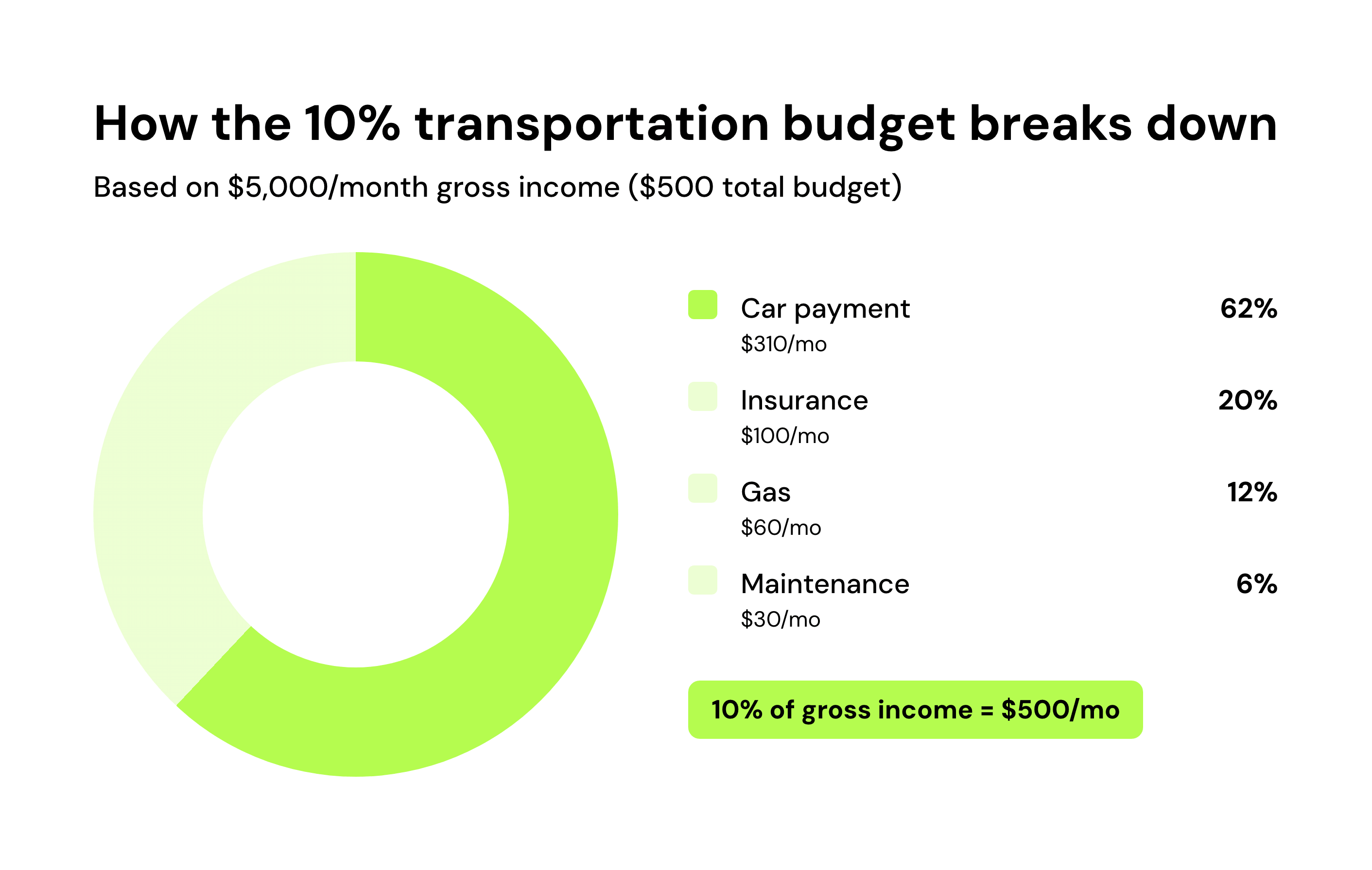
- Car payment
- Insurance
- Gas
- Maintenance and repairs
While your vehicle payment is fixed, other expenses, such as fuel and insurance, fluctuate. If you are purchasing a new vehicle with a three-year warranty, the vehicle shouldn't have any out-of-pocket repairs during the first 36 months of your loan (unless you outdrive the warranty limits).
Still, staying under the 10% limit can be tough, especially if you are shopping for a brand-new vehicle.
Is the 20/4/10 rule realistic?
Yes, the 20/4/10 rule is a viable option for most borrowers, but it can be tough to follow, especially in today's market. The rule is most realistic if you:
- Have a stable income
- Can save for a down payment
- Are open to buying a used or more affordable vehicle
- Have good or improving credit
However, it may be more difficult to stick to the 20/4/10 rule if:
- You need a vehicle right now
- You have limited savings
- Your credit is low or still developing
In these cases, you may need to put less money down, take on a longer loan term, or both.
Pros and cons of following the 20/4/10 rule
The benefits of following the 20/4/10 rule include:
- A lower risk of overbuying
- Reduced financial stress
- Limited interest over the life of the loan
- Encourages healthier financial habits
The downsides include:
- The rule may limit your vehicle options
- You need to save 20% down
- It's not always practical when you need a car right now
The 10% cap can feel restrictive for some borrowers, especially if you drive a lot and have high fuel costs.
What to do if you can't meet the 20/4/10 rule
If part or all of the 20/4/10 rule puts buying the vehicle you need out of reach, you can:
- Adjust your budget
- Save a smaller down payment
- Improve your credit before applying
- Consider a longer loan (but be cautious)
- Focus on the total cost
Before you take on a vehicle loan, make sure you can reasonably afford both the monthly payment and other costs. Otherwise, your vehicle will become a financial burden.
Conclusion
If you are going to use the 20/4/10 rule for buying a car, you want to keep your transportation costs as low as possible so that you can stay within the 10% threshold. One way to get more for your budget is to achieve a lower interest rate on your auto loan. That means building your credit profile and increasing your credit score.
Platforms like Kikoff can help you boost your credit score, which will lead to better interest rates and a lower car payment. Kikoff offers a variety of tools to strengthen your credit history, including:
- A free Kikoff credit account
- A three-tiered annual subscription
- Rent reporting
- An invite-only credit builder loan
- Free dispute tools
- Free debt negotiation
Ready to get started? Use on-time payments to build credit with Kikoff.
Frequently Asked Questions
About the editor

Article Sources
Disclaimer: The information provided in this blog post is meant for informational purposes only and does not constitute financial advice.