





When you need cash fast, many options, like payday loans, cost a lot and can leave you worse off. Earned wage access (EWA), also called on-demand pay, is another option. It lets you use part of the pay you’ve already earned before your next payday.
EWA usually comes with a small fee, and there’s a limit on how much of your next paycheck you can get early.
What is earned wage access?
Say you're paid on the 15th and 30th, and an emergency bill comes due on the 7th. By then, you've already earned a week’s worth of wages. EWA lets you use some of that money now instead of waiting. There’s no interest and usually no credit check. You’ll often pay a fee for getting the money instantly, and whatever you take comes out of your next paycheck. It’s why EWA usually costs less than a payday loan. It’s also why your next check can come up short.
How does earned wage access work?
How EWA works depends on who offers it. It comes in two forms: programs your employer offers and apps you sign up for on your own.
Employer-integrated programs
Some major employers, including universities, hospitals, and corporations, have rolled out EWA programs as an employee benefit.
Companies partner with EWA platforms, and the platform connects directly to the workplace payroll system. As you work hours and earn wages, you can request a withdrawal through the payroll app or EWA platform. When you request a withdrawal from your earned income, the provider sends the money directly to your bank account or card. A standard transfer can take a day or more, with instant delivery usually for a fee.
Many employer programs offer a no-fee option, usually the slower transfer. Ask HR what’s free and what costs extra before your first withdrawal.
Direct-to-consumer apps
If your employer doesn't offer EWA, you can use a direct-to-consumer app. These apps link to your bank account, look at your deposit history to decide how much you can get, and then take the money back from your account on payday.
Depending on the app, you may pay a monthly subscription, an instant-delivery fee, or a “tip” the app suggests. Some apps set a tip by default, so check the amount before you confirm.
Grant Cash Advance offers $25 to $500 to eligible customers, with no interest, no credit check, and no late fees, with same-day delivery for a fee. Repayment comes out of your bank account once your paycheck arrives.
How do payday loans compare to earned wage access?
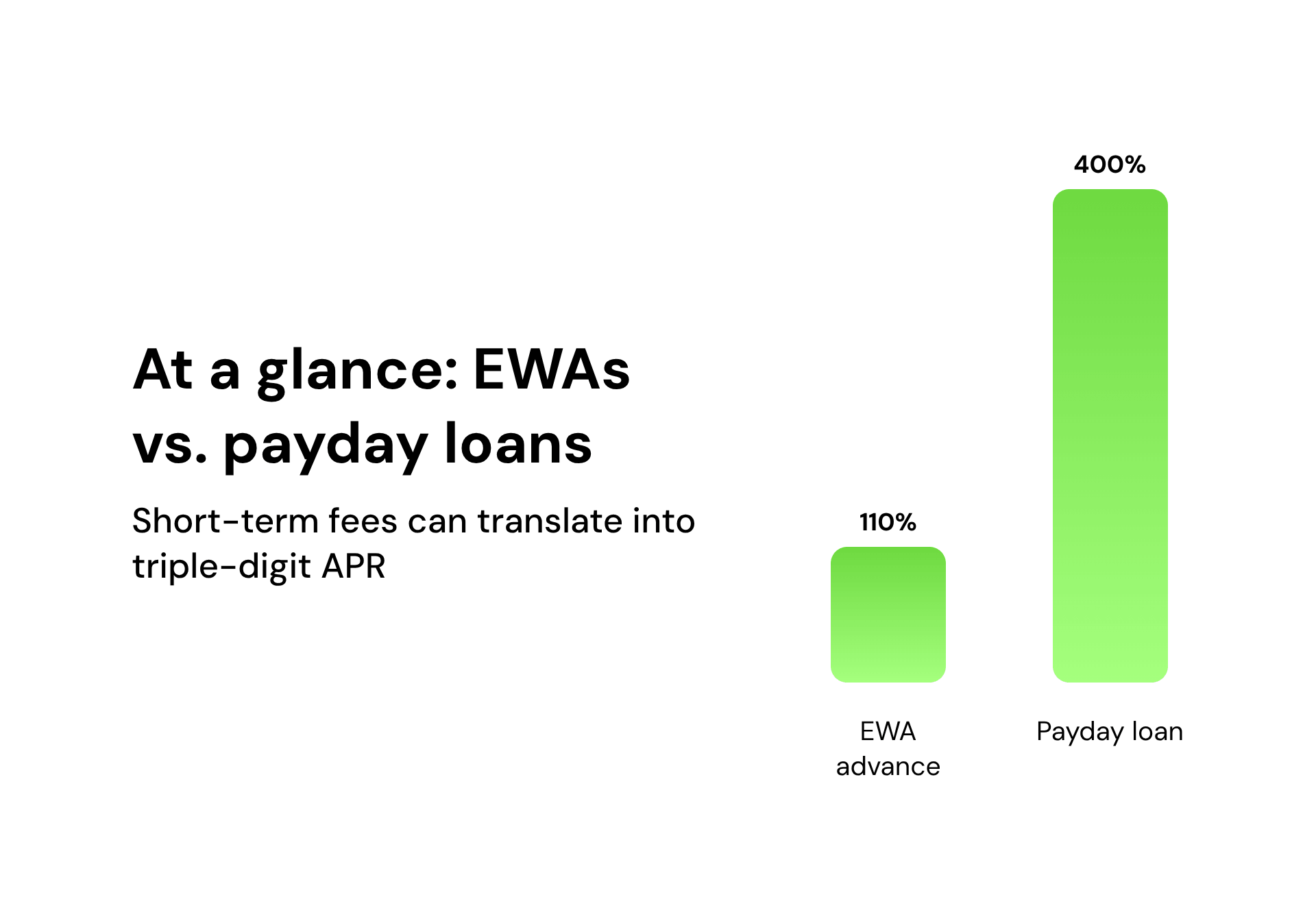
Payday loans and EWA platforms are options when you need extra cash before your next payday, but payday loans are true loans. By contrast, EWA platforms just give you access to money you already earned. And, EWA programs have much lower overall costs. Here's how they compare:
A $3 fee on a $100 advance doesn’t sound like much for an EWA. But because you repay it in about 10 days, it works out to roughly 110% APR. A payday loan costs far more: at $15 per $100 for two weeks, the APR is almost 400%. EWA is the cheaper option, but it’s not cheap money.
Pros and cons of earned wage access
Pros
- No credit check. EWA is based on your pay, not your credit, so you won’t typically face a credit check.
- No interest charges. You pay fees, not interest.
Cons
- Fees can add up. Fees are small per withdrawal but add up if you use EWA every pay period. Instant delivery costs more.
- Your next check will be smaller. Whatever you take now comes out of your next paycheck, so the next one falls short too.
- Your repayment can overdraw your account. If an app debits your bank on payday and your pay hasn’t yet hit, your bank may charge an overdraft or NSF fee. Ask the app what day it takes the money.
Read more >> How to Get an Emergency Loan With Bad Credit
When one advance leads to the next
Each advance makes the next paycheck smaller, which can leave you needing another. In a 2024 CFPB study of employer programs, the average worker used EWA 27 times a year.
Three ways to break the cycle instead of carrying it forward:
- Call the company whose bill is due and ask for a later date.
- Ask a local credit union about a payday alternative loan, which you repay over months rather than out of one paycheck.
- Talk to a nonprofit credit counselor about lining your bills up with your paydays. The National Foundation for Credit Counseling can connect you to free or low-cost help at 800-388-2227.
Bottom line
EWA can cover a short gap for far less than a payday loan, especially if you choose the free standard transfer when you can wait a day.
What it won’t do is leave a record. Paying it back on time every payday generally doesn’t reach your credit report, so it can’t help you qualify for lower-cost credit the next time a bill lands before payday. Kikoff’s Credit Account reports your on-time payments to Equifax, Experian, and TransUnion, with no credit check to sign up. Plans start at $5 a month.
Frequently Asked Questions
Article Sources
Disclaimer: The information provided in this blog post is meant for informational purposes only and does not constitute financial advice.