

.jpg)


To many people, having a bank account is essential to have paychecks deposited, pay bills, and earn interest. It might surprise you to learn that in the United States, there are millions of people without banking services.
As access to banking has improved, the number of unbanked and underbanked people has fallen to record lows. But for people who still can’t access adequate banking services, everyday life is more expensive.
Take a look at the changing underbanked and unbanked population in the U.S. over time and examine the factors that drive those changes.
What unbanked and underbanked mean
According to the Federal Deposit Insurance Corporation (FDIC), there is a difference between “unbanked” and “underbanked” households[1]:
- Unbanked: No one in the household has a bank or credit union account
- Underbanked: At least one person has a bank or credit union account, but the household mostly relies on non-bank products and services
Non-bank financial services include:
- Check-cashing services
- Non-bank money orders
- Prepaid debit cards
- Title loans and payday loans
Being unbanked or underbanked might not seem like a significant disadvantage. However, these households have to contend with several threats to financial health, including:
- They may have little or no credit history, which makes it difficult to finance a car, take out a mortgage, or otherwise access mainstream credit
- If they turn to title loans or payday loans in emergencies, they may be trapped in a long-term debt cycle
- Non-mainstream credit often comes with very high interest rates
- If they keep money outside of a bank, they don’t benefit from FDIC insurance
- They miss out on interest earnings
Even something as seemingly minor as relying on check-cashing businesses can be costly over time. Most check-cashing businesses take 1% to 12% of a paycheck,[2] which can make a significant difference in someone’s standard of living. That’s particularly true for households that are already struggling.
How the unbanked and underbanked population has changed over time
The FDIC National Survey of Unbanked and Underbanked Households has tracked trends in these households since 2009[3]. The survey is conducted biennially, and it tracks metrics like these:
- The national unbanked rate
- Unbanked rates by race and other household characteristics
- Reasons for unbanked households not having a bank account
- Types of non-bank financial services used for transactions
- Use of different kinds of mainstream credit by bank account ownership
- Use of payday loans and other alternatives to mainstream credit
- Rate of transition to bank account ownership
- What methods banked households use to access bank accounts
The 2023 survey (the most recent available) found that 4.2% of households were unbanked and 14.2 % were underbanked[4].
Trends from 2009 to the present
The national unbanked rate spiked in 2011, but since then, it’s been on a downward trajectory[4]:
- 2009: 7.6%
- 2011: 8.2%
- 2013: 7.7%
- 2015: 7.0%
- 2017: 6.5%
- 2019: 5.4%
- 2021: 4.5%
- 2023: 4.2%
The underbanked rate has seen a largely downward trend as well, although the underbanked rate rose very slightly between 2021 and 2023:
- 2009: 17.9%[5]
- 2011: 20.1%[6]
- 2013: 20.0%[7]
- 2015: 19.9%[7]
- 2017: 18.7%[7]
- 2019: No data listed*
- 2021: 14.1%[8]
- 2023: 14.2%[4]
*In 2019, the FDIC changed the name of the report to “How America Banks: Household Use of Banking and Financial Services.” It didn’t include data on underbanked households[9].
Even among the unbanked population in the U.S., the use of non-bank check cashing has decreased. However, unbanked households continue to use these services at a much higher rate than banked households[4]:
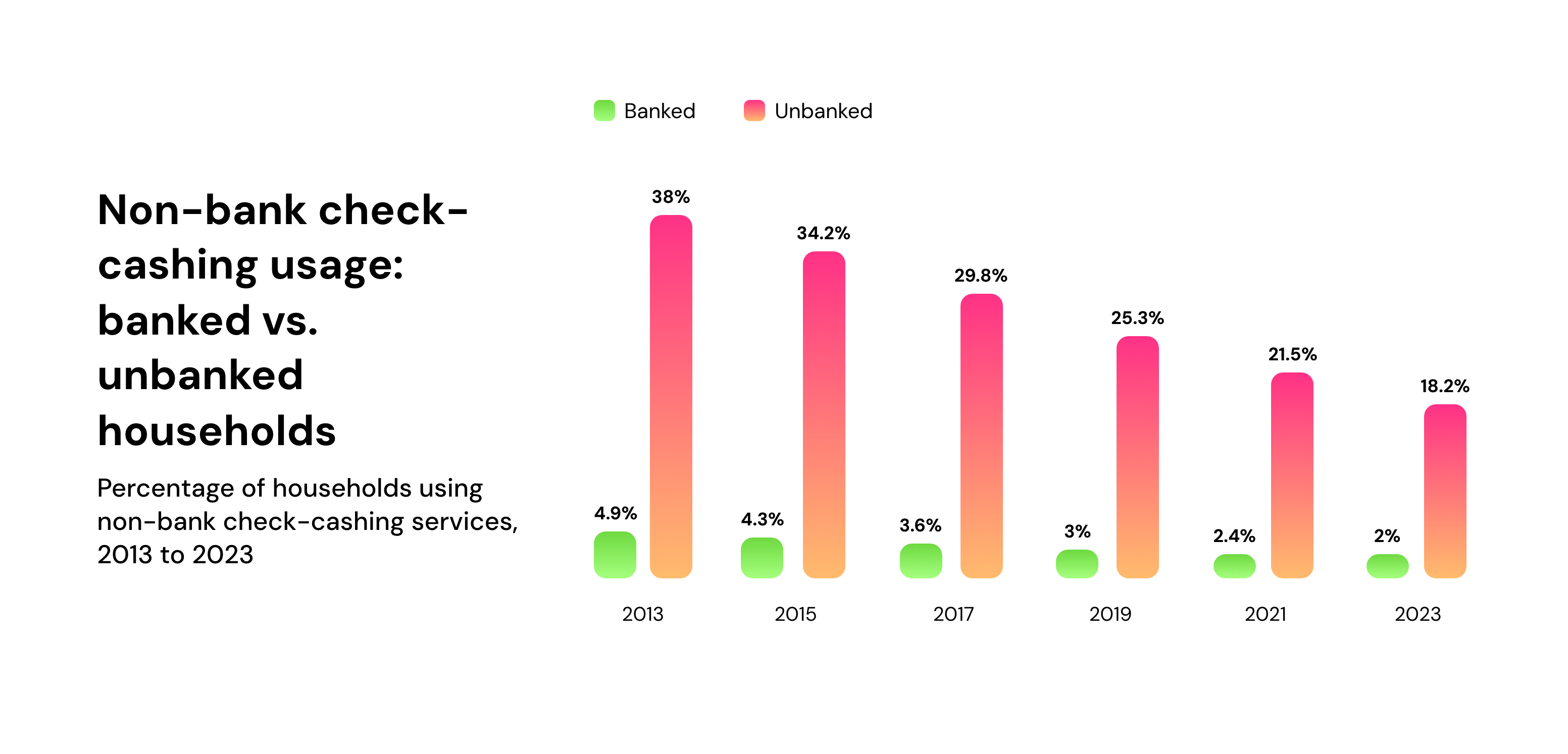
- 2013: 4.3% banked, 38% unbanked
- 2015: 4.9% banked, 33.8% unbanked
- 2017: 4.7% banked, 30.2% unbanked
- 2019: 4.0% banked, 31.9% unbanked
- 2021: 2.3% banked, 21.8% unbanked
- 2023: 2.0% banked, 18.2% unbanked
The number of households with no mainstream credit has also decreased. The FDIC reports that in 2023, 15.7% of households had no mainstream credit (compared to 20% in 2017). However, unbanked households account for most of this number. In 2023, 78.4% of unbanked households had no mainstream credit at all[4].
Ultimately, the numbers are moving in the right direction with more people accessing bank accounts and avoiding high-interest mainstream credit alternatives.
The impact of the 2008 financial crisis on banking access
The FDIC only started tracking banked and unbanked households in 2009. Had it begun tracking them prior to 2008, there would probably be a drastic change in data following the 2008 financial crisis.
In the wake of the crisis, banks were subjected to new regulations. Some of these regulations helped protect new borrowers, but they also created an environment that made bank access more difficult for some, including:
- Many banks raised fees and set higher minimum account balances, which priced some people out
- Higher credit requirements and strict “ability-to-repay” standards made it harder for those with poor credit to access loans and credit cards
- Bank consolidation and branch closures made it difficult for many in rural areas to access physical branches
In recent decades, fintech companies and other non-bank lenders have become more prominent. To a certain extent, these companies (as well as mobile banking offered by traditional banks) made it easier for households to access banking services.
Who is most likely to be unbanked or underbanked?
The FDIC survey doesn’t just keep track of the number of banked and unbanked households. It also looks into the factors that make households less likely to engage with banks and mainstream credit products.
Income as the primary driver
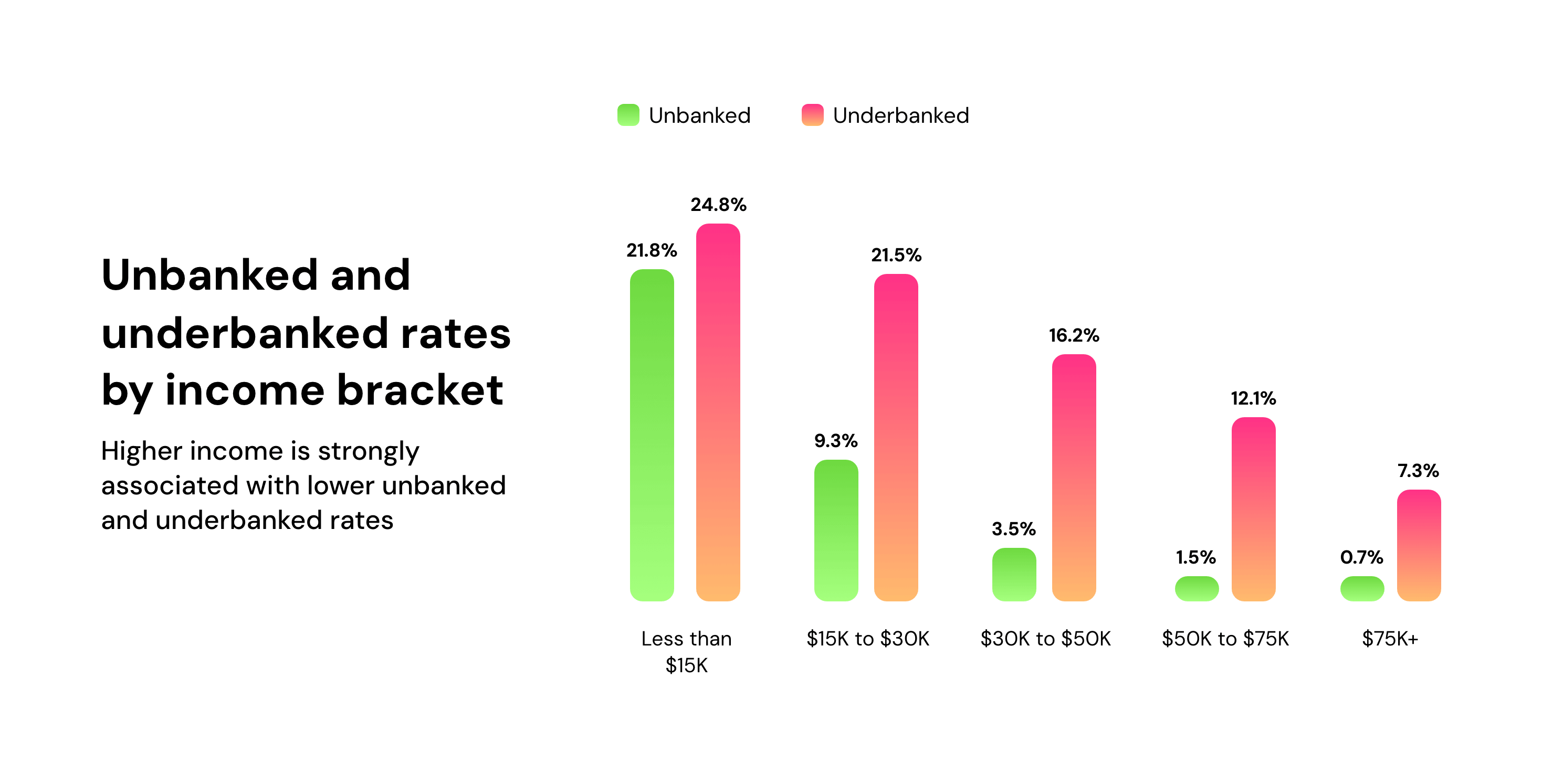
Although many factors contribute to households being unbanked or underbanked, income is the most important. The 2023 survey looked at the distribution of various annual income levels across banked and underbanked households[4]:
- Less Than $15,000: 21.8% of unbanked households, 16.9% of underbanked
- $15,000-$30,000: 9.0% of unbanked, 18.8% of underbanked
- $30,000-$50,000: 4.5% of unbanked, 17.8% of underbanked
- $50,000-$75,000: 1.8% of unbanked, 15.4% of underbanked
- $75,000 or More: 0.7% of unbanked, 10.7% of underbanked
Many lower-income households are deterred from traditional banks by high minimum balance requirements, fees, or both.
Education
The survey also found that people with lower levels of education were more likely to be unbanked or underbanked[4]:
- No High School Diploma: 19.7% of unbanked households, 23.1% of underbanked
- High School Diploma: 6.5% of unbanked, 16.0% of underbanked
- Some College: 3.0% of of unbanked, 15.7% of of underbanked
- College Degree or Higher: 0.8% of unbanked, 10.4% of underbanked
Statistically, those with lower educational levels are more likely to make lower incomes, which may explain the gap. Some studies have indicated that those with greater financial literacy are more likely to trust central banks[10], and many people who have attained higher levels of education are more financially literate.
Race and ethnicity
Unbanked and underbanked rates varied significantly based on race and ethnicity[4]:
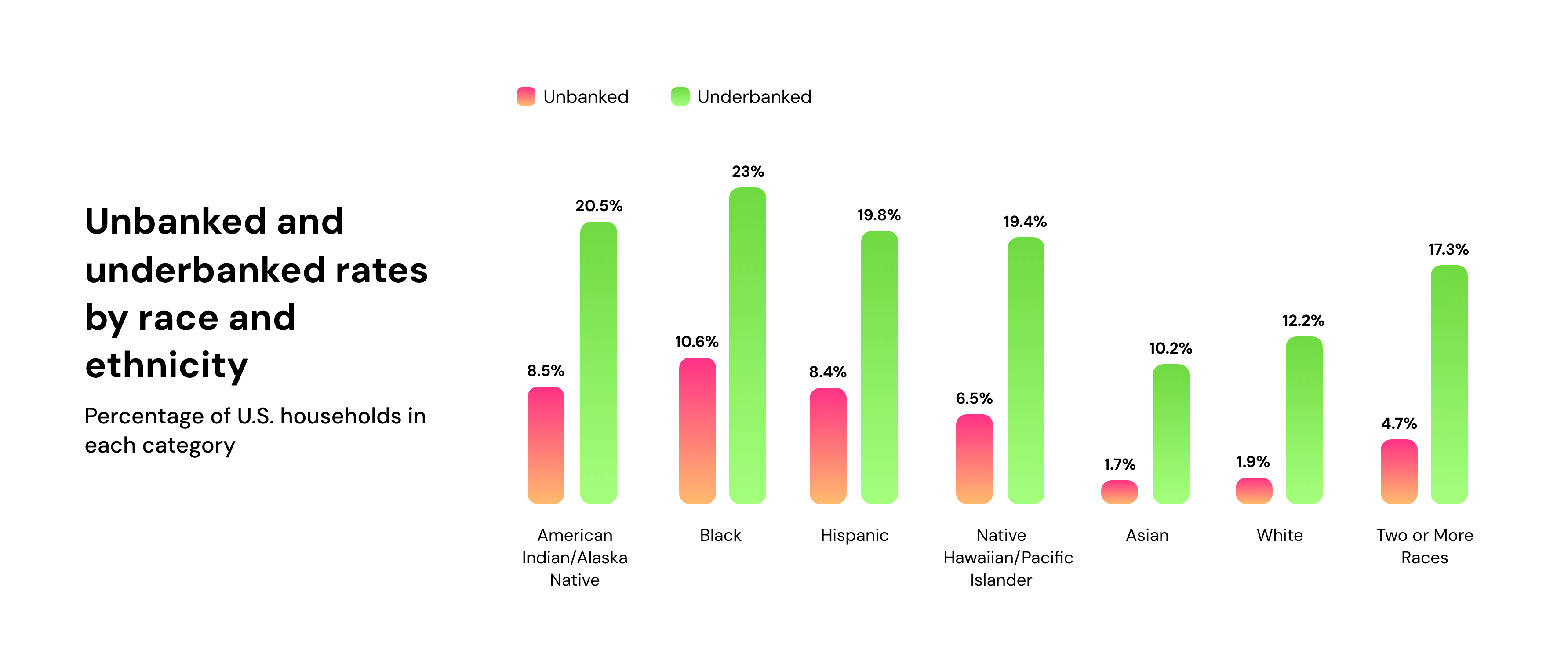
- Asian: 2.0% of unbanked households, 16.8% of underbanked
- American Indian/Alaska Native: 12.2% of unbanked, 21.9% of underbanked
- Black: 10.6% of unbanked, 23.8% of underbanked
- Hispanic: 9.5% of unbanked, 21.7% of underbanked
- Native Hawaiian/Pacific Islander: 4.8% of unbanked, 27.0% of underbanked
- White: 1.9% of unbanked, 10.1% of underbanked
The survey also included those with a racial makeup including two or more races. These survey respondents accounted for 2.5% of unbanked households and 16.8% of underbanked households.
Age and disability status
Unbanked and underbanked rates saw some variation by age group as well[4]:
- 15-21: 5.9% of unbanked households, 20.8% of underbanked
- 25-34: 5.2% of unbanked, 17.6% of underbanked
- 35-44: 4.7% of unbanked, 15.4% of underbanked
- 45-54: 4.3% of unbanked, 15.8% of underbanked
- 55-64: 4.4% of unbanked, 13.6% of underbanked
- 65+: 2.9% of unbanked, 9.8% of underbanked
The survey also looked at the distribution of working-age households (defined as age 25-64) with and without a disability. Working-age households with a disability accounted for 21.5% of unbanked households and 12.1% of underbanked households.
Working-age households with no disability accounted for 52.5% of unbanked households and 61.8% of underbanked ones.
Rural geography
The study found that respondents who did not live in metropolitan areas faced various challenges that could limit access to banking. For instance, the share of households without mainstream credit was higher in those outside of metropolitan areas.
Smartphone access was lower for rural households, which may make it more difficult to access mobile banking.
Why people are unbanked or underbanked
The 2023 FDIC National Survey of Unbanked and Underbanked Households asked unbanked households why they didn’t have a bank account. These are some of the top cited reasons[4]:
- Not having enough money to meet minimum balance requirements (42.3%)
- Not trusting banks (15.7%)
Notably, 33.4% of the unbanked population in the U.S. surveyed cited another reason related to fees, minimum balances, or both. However, these aren’t the only reasons for households being unbanked or underbanked.
Understanding why people are unbanked or underbanked is a crucial part of financial inclusion in the United States.
Minimum balance requirements and fees
Some banks require you to deposit a certain amount of money to open a bank account. Many also have minimum daily balance requirements. If you’re someone who’s living paycheck-to-paycheck or makes relatively little money, it might not be possible to meet these thresholds.
Some banks also charge account maintenance fees and other fees. For people who have had bad experiences with surprise fees in the past or who want to avoid them in the first place, opening a bank account may seem like an unwise idea.
Prior banking history and ChexSystems
If someone has previously had a bank account closed due to overdrafts, they might be interested in opening a new account and starting fresh. Unfortunately, that’s not always possible.
Most banks use ChexSystems, which tracks banking activity. Before allowing someone to open a bank account, most institutions will take a look at their ChexSystems report. The system may flag someone as too risky for reasons like these:
- Unpaid overdraft balances
- Forced account closures due to misuse or insufficient funds
- Suspected fraud
- Having applied for too many bank accounts in a short period of time
If someone has been effectively blacklisted by ChexSystems, a bank account might not be out of reach. Many banks offer “second-chance checking accounts” to help rebuild banking records. However, these accounts often come with fees or minimum balance requirements, which may be out of reach for some people[11].
Lack of documentation and eligibility barriers
Most banks require significant documentation for someone to open an account. Specifically, most will ask for a government ID, Social Security number, and proof of residency. For someone who doesn’t have a permanent address or has just immigrated to the country, coming up with this documentation might not be possible.
Distrust and past negative experiences with banks
People of many backgrounds have a general sense of distrust toward banks. Some are wary of aggressive sales tactics by bank representatives, and others might prefer to keep all transaction history private.
Many unbanked and underbanked people have also had negative experiences with banks or have family members who have. Historically, many banks and lenders openly discriminated against women and racial minorities. For some, that can be reason enough to avoid them.
The financial products unbanked and underbanked Americans rely on
If someone doesn’t have a bank account (or has an account they rarely use), how do they manage money in daily life? Unbanked and underbanked households routinely use a range of financial products.
Check cashing, money orders, and prepaid cards
If you have a bank account, your check is probably deposited directly. If you don’t have one, you might have to rely on an alternative service. Some people without bank accounts take paychecks to check-cashing businesses.
Check cashing does have an advantage. You access funds immediately instead of waiting days for a deposit to clear. However, high fees can take up a large portion of the check.
Money orders are another option to send funds when needed. For example, if you must pay rent by mail and a landlord doesn’t accept personal checks, you might need to purchase a money order (which is much like a pre-paid check) and mail it. However, money orders come with fees, and they can’t be written for more than $1,000[12].
Payday loans and other high-cost alternatives
Almost everyone runs into a financial emergency periodically. If you don’t have an emergency fund, a credit card, or someone who can lend you money, you might need to turn to a non-traditional credit product.
Payday loans are an example. These are short-term loans with extremely high interest rates. Many have APRs of 400% or more[13]. If you can’t repay a payday loan on time, you may be able to roll it over (or continue it). Interest keeps accruing, and you might end up paying many times what you initially borrowed.
Title loans are another high-cost form of alternative credit. The borrower gives their car title as collateral for the loan. Secured loans typically have lower interest rates than unsecured loans, but that’s not the case with title loans. They often have APRs that are comparable to payday loans[14], and if a borrower defaults, they lose their vehicle.
The cost premium of banking outside the mainstream
Most of these alternative banking options are costly (either immediately or over time). Many unbanked and underbanked households have relatively low incomes, and unfortunately, a lack of banking access can hinder their financial mobility even further.
FAQ
How many households don’t have bank accounts?
As of 2023, about 5.6 million households in the U.S. (4.2%) are unbanked[4].
Are fintech and mobile banking closing the banking gap?
To some extent, yes. Banking online means there’s no need to open an account at a physical bank. However, for those with no or limited internet access or poor digital literacy, these tools may not be feasible.
Can you open a bank account after being blacklisted?
In many cases, you can. Opening a second-chance checking account is an option. If you’re unable to do that, keep in mind that negative marks on ChexSystems reports usually come off after five years.
Understanding trends in banked and unbanked households
There’s no singular factor that determines why someone does (or doesn’t) use a bank account or mainstream credit. Lack of physical access, prohibitive fees and minimum balance requirements, and lack of trust in banks all contribute.
If you’re part of the underbanked and unbanked population in the U.S. and want to access more mainstream credit products, building credit is a great place to start. Just like bank access, a good credit score can create financial opportunities down the line.
Frequently Asked Questions
About the editor

Article Sources
Disclaimer: The information provided in this blog post is meant for informational purposes only and does not constitute financial advice.