.jpg)



Credit and borrowing funds are synonymous with the American way of life and have been for decades. Americans use credit to buy homes, go to college, start businesses, and help cover everyday expenses. However, the credit system has only existed in its current state for about three decades, and it’s constantly changing.
Looking back at the origins of the United States credit system can help reveal how far it has come and where it is headed. In the early days of the nation, credit systems relied on personal relationships. However, these systems were not scalable, and they were prone to implicit biases.
Learn about the history of credit and how Americans borrowed and lent money before the big three credit bureaus took over the landscape. While financial products are more accessible than ever, some groups are still at a disadvantage.
How credit worked before modern banking
Americans have borrowed and lent money since the nation’s inception, and even before. The earliest forms of credit were based on personal relationships and reputations within small communities.
It wasn’t until the late 1800s that credit became a more scalable concept. Even then, those setups were quite limited and lacked the current standardization.
These informal systems laid the foundation for many of the concepts that would later shape today’s lending environment.
Colonial-era debt and merchant credit
During the colonial era, cash was scarce outside of major port cities. As a result, merchants regularly extended credit to customers so they could purchase goods and settle debts later.
Each merchant kept a store ledger, which served as a record of borrowing and repayment. Merchants expected debts to be paid after a harvest or successful trade shipment.
Merchant credit became a critical part of the colonial economy. Consumers purchased everything from household supplies to farming equipment on an account. Merchants often relied on credit from suppliers in England and elsewhere. Bartering was also commonplace in colonial America.
Crop liens, company stores, and credit in the rural economy
As the United States expanded westward, agriculture remained one of the most dominant industries. Rural borrowers developed different forms of credit relationships. One of the most common systems involved crop liens, which allowed farmers to pledge future harvests as collateral to obtain supplies and financing.[1]
The use of crop liens became even more widespread after the Civil War. Many in the south viewed them as predatory, calling them “crap liens.” [1]
These liens created long-term debt burdens that could leave borrowers trapped in recurring cycles, especially if commodity prices fell or they had a poor harvest. These liens also led some to overpurchase on credit, which is a common theme today.
The role of personal reputation in early lending
Before credit reports and scoring models existed, personal reputation was often one of the most important factors in lending decisions.
Local bankers and merchants typically knew the people they were lending money to, which made it possible to evaluate borrowers on a case-by-case basis. However, bias was certainly a part of the lending process.
A person’s character, family history, and social standing influenced whether they received a loan or not. As people became more mobile and populations grew, reputation-based lending became difficult to sustain.
Lenders had no way of vetting people based on personal knowledge when dealing with out-of-towners and traveling business people. This change in how people lived and moved about the country created a need for standardized evaluation methods.
The rise of consumer credit in the 20th century
The 20th century transformed credit from a localized financial tool into a central feature of American consumer life and the U.S. economy. Industrialization, urbanization, and mass production created demand for financing options that could help households purchase increasingly expensive goods.
During this period, consumer lending expanded dramatically, laying the groundwork for today’s credit economy.
Installment plans and the birth of buy now, pay later
One of the biggest developments in the history of consumer credit was the rise of installment lending. Retailers allowed customers to make a down payment and pay the remainder over time.
The automobile market was largely responsible for popularizing installment credit. Car ownership became a symbol of middle-class life, but most Americans couldn’t afford to purchase a vehicle outright. Financing programs made vehicle ownership possible for millions of Americans. Household appliances and furniture soon followed.
While installment plans date back to the early 1900s, the digitization of finance has made taking out installment plans far easier. In the late 2010s, this evolved into buy now, pay later (BNPL). The BNPL market has exploded, offering consumers a unique version of point-of-sale financing.
According to the Consumer Financial Protection Bureau, 19.8 million BNPL loans originated in 2019. [2] By 2023, that figure had exploded to over 335 billion loans, totaling more than $45.2B in funding.

The Great Depression and its effect on lending
The Great Depression remains one of the bleakest periods in the financial history of America. From 1930 to 1933, the supply of money fell by almost 30%, and average prices dropped by roughly the same amount. [3] Millions of borrowers struggled to repay loans, resulting in default.
Financial institutions clamped down on lending standards and made credit less available. Policymakers at the federal level recognized the need for stronger oversight and lending practices.
The economic hardships of the 1930s also influenced future attitudes toward borrowing for decades, including in the immediate post-WWII era. Borrowers were more aware of the risks caused by taking on too much debt.
Post-WWII prosperity and the democratization of credit
Following World War II, America experienced a surge in income and suburban development. Americans enjoyed better access to credit, and the FHA lending program, which was launched in 1934, really picked up momentum after the war. [4]
Government-backed mortgage programs helped millions of families purchase homes. Consumer lending expanded to support spending on automobiles, appliances, and education.
Over the next few decades, banks and finance companies launched new lending products aimed at supporting the growing middle class. By the latter half of the century, credit was becoming a routine part of the everyday life of Americans.
Here’s a look at how the amount of outstanding consumer credit has grown in the U.S. since WWII:[12]
| Year | Total Consumer Credit Owned and Securitized (USD) |
|---|---|
| 1950 | $19,050,000,000 |
| 1960 | $56,015,000,000 |
| 1970 | $127,802,000,000 |
| 1980 | $350,475,000,000 |
| 1990 | $797,714,000,000 |
| 2000 | $1,538,520,000,000 |
| 2010 | $2,543,508,000,000 |
| 2020 | $4,171,617,000,000 |
| 2026 | $5,106,840,000,000 |
The legal framework that shaped modern credit
By the second half of the 1900s, lawmakers realized that the country’s credit system was expanding rapidly. In response, federal lawmakers created several acts designed to protect consumers and promote transparency. These bills still impact how you borrow today.
The Fair Credit Reporting Act (1970)
The Fair Credit Reporting Act established rules governing how consumer credit information could be collected, shared, and used. [5] Before the act was passed, credit reporting practices often lacked transparency and consistency.
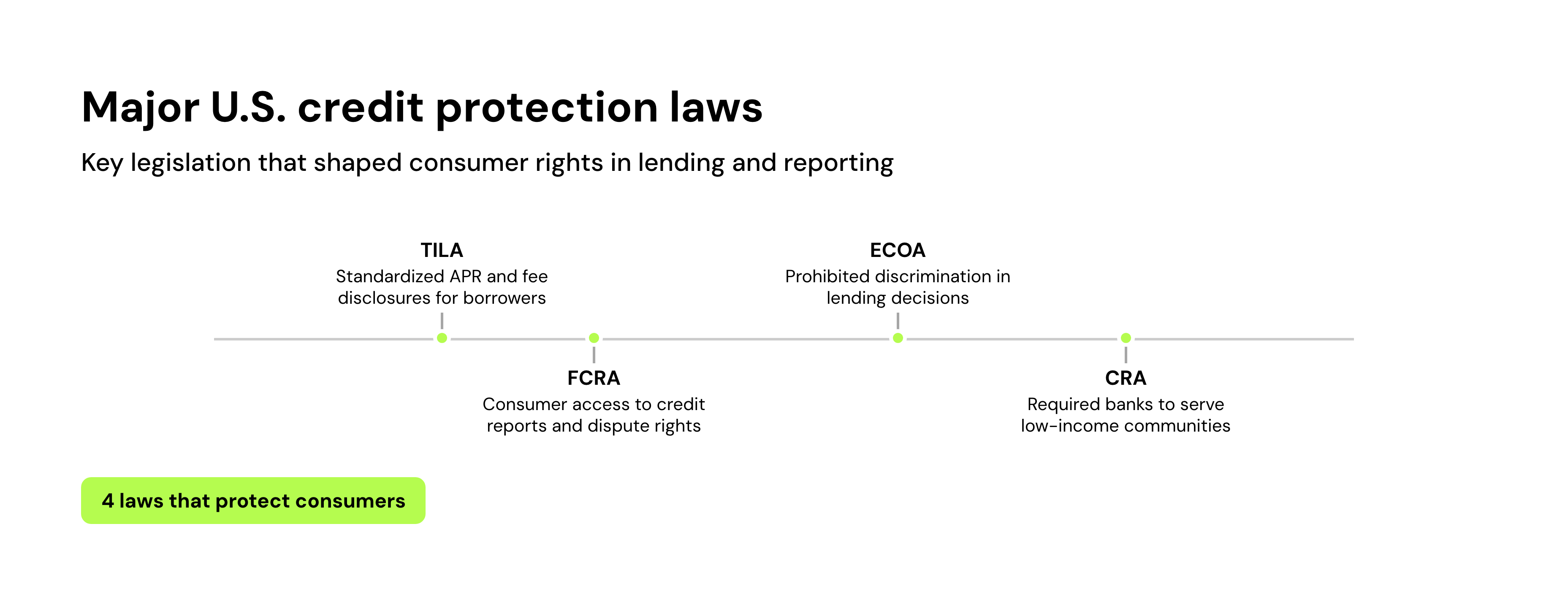
The FCRA gave consumers important rights, including access to their credit reports and the ability to dispute inaccurate information. The law remains one of the most important pieces of legislation governing the modern credit reporting system.
Every time you request one of your credit reports or dispute an error, you can thank the FCRA and the laws that have followed. These rights allow you to protect your credit reputation and ability to borrow.
The Equal Credit Opportunity Act (1974)
The Equal Credit Opportunity Act (ECOA) prohibited discrimination in lending based on factors such as race, color, religion, national origin, sex, marital status, age, or receipt of public assistance. [6]
Before the law was passed, many Americans faced barriers to obtaining credit based on characteristics unrelated to their financial qualifications. ECOA sought to ensure lending decisions were based on a person’s creditworthiness.
The ECOA was a vital step toward making access to credit equitable in the post-Civil Rights era. It made the credit system fairer for all Americans.
The Community Reinvestment Act (1977)
The Community Reinvestment Act (CRA) was designed to encourage banks to meet the credit needs of the communities they serve, with a focus on low- and moderate-income areas. [7]
The law emerged partly in response to concerns about redlining, which is a practice that some lenders used to avoid providing loans in certain geographic areas. They would quite literally draw a red line along borders between neighborhoods to identify areas that were off-limits for funding.
Since the CRA, regulators evaluate financial institutions’ compliance with the act’s requirements. Some question the effectiveness of the Community Reinvestment Act, but it remains an important part of efforts to expand access to financial products and services.
The Truth in Lending Act and consumer disclosures
The Truth in Lending Act (TILA) created standardized disclosure requirements for credit products and consumer loans. [8] Lenders must clearly communicate certain information to you, such as the APR, fees, and repayment terms.
The TILA helps consumers compare financial products and make more informed borrowing decisions. Many of the disclosures you encounter today stem directly from the requirements established under this legislation.
How credit scoring changed everything
In the 1980s, the credit scoring system that we know today finally took shape. Financial institutions needed a more efficient and consistent way to evaluate risk.
Credit scoring allows for standardized decision-making and supports lending on a much larger scale. National institutions can evaluate borrowers more fairly by using their credit scores.
The origins of FICO and standardized scoring
A major milestone in how credit scoring was developed occurred in 1956, when engineer Bill Fair and mathematician Earl Isaac founded Fair, Isaac, and Company, now known as FICO. [9] The duo wanted to apply statistical analysis to lending decisions by creating a predictive model to estimate how likely a borrower was to repay a loan.
Over time, credit scoring became central to mortgages, auto loans, and credit cards. A standardized score enables lenders to process applications more quickly and consistently. While the scoring model wasn’t flawless, it was fairer than previous decision-making processes.
The three major bureaus and how they developed
Today, America’s credit reporting system relies on the big three credit bureaus, which are Equifax, Experian, and TransUnion. [10] All three of these organizations began as regional reporting agencies that collected information about borrowers and shared it with lenders.
Over several decades, each bureau became larger and more sophisticated in how it collected data.
Today, lenders use data from one or more of these bureaus to assess credit risk and make lending decisions. As a consumer, you are entitled to one free credit report per year per bureau. Lenders don’t always report to all three bureaus, so there can be minor discrepancies between your reports.
Criticism, bias, and calls for reform
Despite the widespread use of credit scoring systems, they aren’t perfect. That’s something practically everyone agrees on.
Critics argue that certain scoring factors may put some groups at a disadvantage. Specifically, individuals with limited credit histories or those who have experienced financial hardship may be unable to access favorable borrowing opportunities.
Others have questioned whether traditional credit data adequately captures the financial behavior of all consumers. For example, renters are at a disadvantage because their on-time rent payments have traditionally not been reported. Conversely, homeowners are credited for on-time mortgage payments.
| Year | Law | What It Changed |
|---|---|---|
| 1968 | Truth in Lending Act | Standardized disclosure requirements for consumer credit |
| 1970 | Fair Credit Reporting Act | Established consumer rights related to credit reporting |
| 1974 | Equal Credit Opportunity Act | Prohibited discrimination in lending |
| 1977 | Community Reinvestment Act | Encouraged lending in underserved communities |
| 2003 | Fair and Accurate Credit Transactions Act | Expanded identity theft protections |
| 2010 | Dodd-Frank Act | Increased consumer financial protections and oversight |
Credit access in America today
Modern credit systems have made financial products far more accessible. However, there are still gaps to address, particularly among low-income Americans. Many consumers have limited access to affordable credit, making them at risk for predatory lending.
Who still lacks access to credit and why
Despite major improvements in lending tech, millions of Americans have insufficient credit histories to generate scores. Consumers may become credit invisible for many reasons, including limited borrowing activity and lack of access to traditional banks.
Some people simply prefer to deal in cash. These challenges illustrate that access to credit remains uneven.
Alternative credit building and fintech’s role
According to the Office of the Comptroller of the Currency, nearly 50 million Americans are credit invisible. [11] Researchers report that this trend disproportionately impacts minorities and poor Americans.
Fintech companies have recently introduced several new options for building credit and making the financial market more inclusive. Many organizations now explore ways to incorporate additional data and payment histories, such as on-time rent and utility payments. This can give you other opportunities for building your credit score.
The new additions to credit reporting can help consumers demonstrate that they are financially responsible without forcing them to take on debt payments. Alternative credit-building products are just one example of how the industry continues to evolve.
FAQ
When did credit scores become widely used in the United States?
Credit scoring models began emerging in the mid-20th century, but the standardized FICO model was not released until 1989. Standardized scoring allowed institutions to evaluate large numbers of applicants more efficiently and consistently.
Why were credit bureaus created?
Credit bureaus were formed because lenders needed a way to assess borrowers they did not know personally or had no previous interactions with. Centralized reporting systems represented a more scalable method for evaluating risk.
Has access to credit always been equal in America?
No, and it still isn’t. For decades, many groups faced barriers to obtaining credit due to discriminatory practices and unequal access to financial institutions. While access to credit is more equitable today, there are still challenges, especially among low-income individuals.
The evolution of credit scores continues
The history of credit in the U.S. is ultimately the story of how trust became data. Early Americans relied on personal relationships, community reputation, and informal agreements. Over time, expanding markets and technological advances paved the way for national credit infrastructure.
As consumer credit has evolved, new benefits and challenges have arisen. Access to credit has created new opportunities for borrowers. At the same time, concerns about fairness and transparency remain. Consumers want to know how their data is being used and whether it is accurate.
Fortunately, consumers who are looking for ways to build credit have more options than ever before. Fintech solutions are making it easier to build credit in low-risk ways. Consumers should closely watch how the credit environment will change in the next few years.
Frequently Asked Questions
About the editor

Article Sources
Disclaimer: The information provided in this blog post is meant for informational purposes only and does not constitute financial advice.