



If you’re planning on buying a home or refinancing a mortgage, your interest rate will impact your total costs. That can add up over the course of a 30-year home loan. Inflation and mortgage rates are closely connected. When consumer prices are on the rise, you may notice mortgage rates increasing right along with it.
Understanding how it works can help you plan for the long term. In some cases, you might even wait for rates to drop before buying or refinancing.
How inflation indirectly affects mortgage rates
Periods of inflation can lead to higher borrowing costs for homebuyers. There are several factors at play here.
The relationship between inflation, bond prices and mortgage rates
Mortgage rates actively track the 10-year Treasury yield, which is the annual return you’d get on a 10-year government bond. Mortgage lenders use this as a gauge when determining mortgage rates.[1]
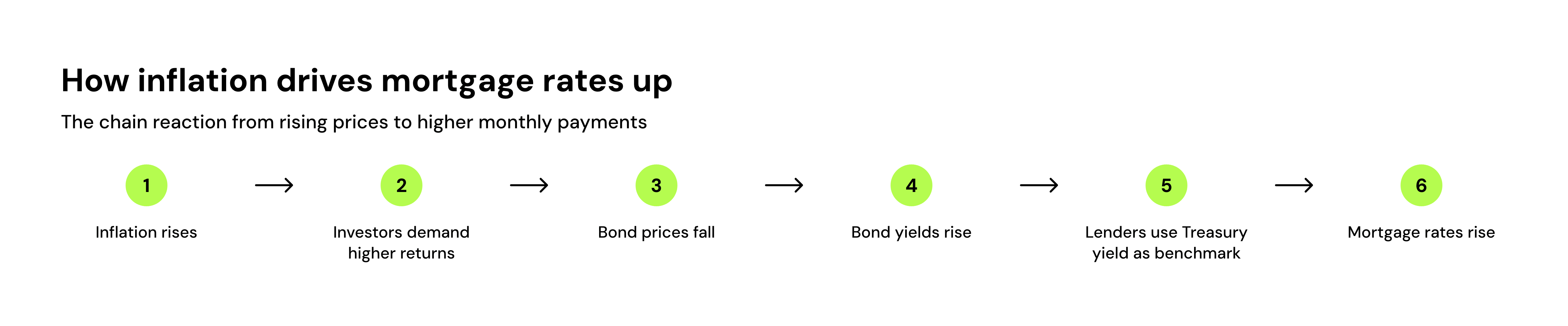
Inflation typically causes bond prices to fall,[2] and bond prices generally move in the opposite direction of bond yields [1] (the annual return an investor earns) and mortgage rates. So when bond prices drop, mortgage rates generally go up.[3]
Inflation erodes a bond’s purchasing power
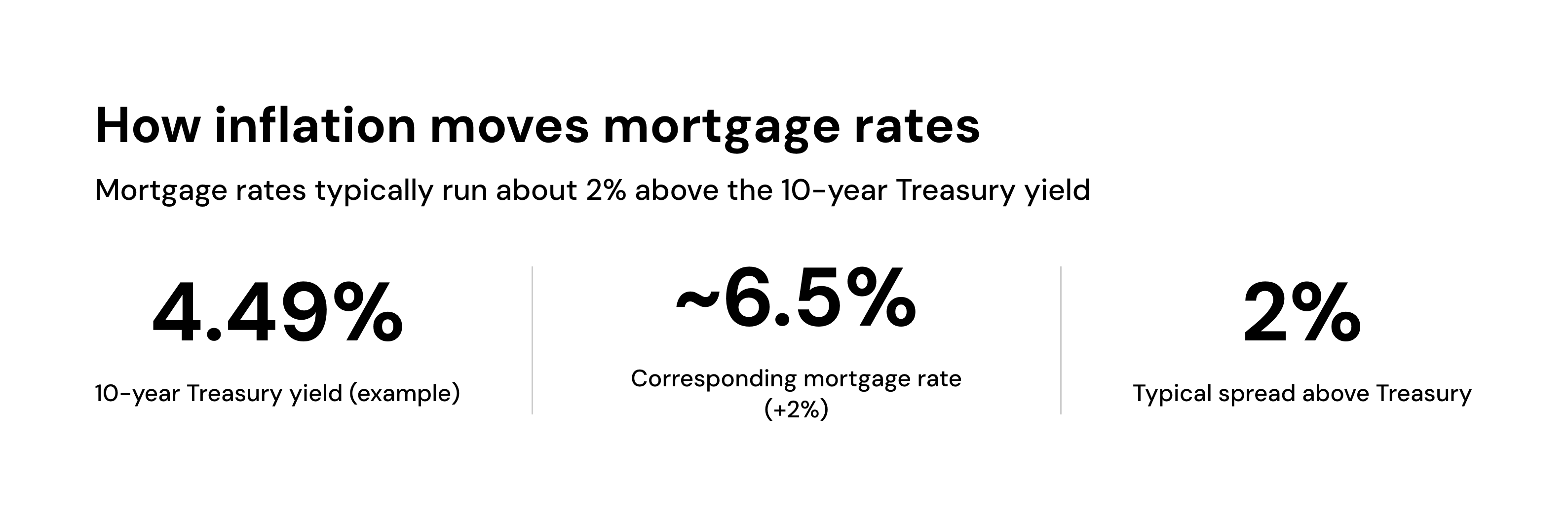
Inflation also chips away at the fixed-rate payments that Treasury bonds provide. Think about it: $100 will probably go a lot further today than it will 10 years from now. If inflation is running high, that gap could be even wider. For example, if the current inflation rate is 4.2%,[4] and you have a 10-year Treasury yield of 4.49%,[5] most of your investment gains will go toward keeping up with rising prices.
How mortgage lenders price inflation risk
Mortgage lenders tend to increase their mortgage rates in response to inflation. That’s partly because a borrower’s future mortgage payments will be worth less.[6] Many lenders also end up selling home loans to Fannie Mae and Freddie Mac; two government-sponsored entities that bundle mortgages to sell to global investors,[7] who may demand higher rates in the face of inflation.
The role of the Federal Reserve
Another factor at play is the federal funds rate. This is a benchmark rate that’s set by the Federal Reserve and used by financial institutions when lending money between each other.[8] It also influences the rates that lenders offer on short-term loans, credit cards and other lines of credit.[9] When the federal funds rate goes up or down, rates on adjustable-rate mortgages often do the same.[10]
The Federal Reserve usually increases the federal funds rate when inflation is running hot. This, in turn, increases the cost of borrowing for consumers and businesses alike. That can help stabilize spending and reduce demand, which can rein in consumer prices.[11] When the federal funds rate goes up, mortgage rates might do the same, but not always. The 10-year Treasury yield is usually seen as a more accurate indicator.[12]
It’s important to note that the federal funds rate is not the same thing as a mortgage rate.
- Federal funds rate: A target lending rate that’s set by the Federal Reserve and may influence mortgage rates.
- Mortgage rate: The interest rate a mortgage lender charges a borrower for a home loan.
What happens to mortgage rates when inflation is high
Again, you’ll likely see mortgage rates go up as bond prices fall. The Federal Reserve might also increase the federal funds rate in response to inflation. Even if the Fed doesn’t make a move, mortgage lenders often increase their rates when inflation is on the rise because future mortgage payments will be worth less.[6]
What happens to mortgage rates when inflation is low
You’ll likely see mortgage rates decline as bond prices go up and bond yields go down. Mortgage rates are generally around 2% higher than the 10-year Treasury yield.[13] So when the Treasury yield drops, mortgage rates usually do the same.
How to plan for a mortgage when inflation is rising
If inflation is ticking upward, and you’re looking to buy a new home or refinance, you may be worried about rising mortgage rates. Here are some options to consider.
Lock in your rate early
Getting preapproved for a mortgage sooner rather than later can allow you to lock in your rate before the lender increases it. Rate-lock periods typically last anywhere from 30 to 60 days.[14]
Look into an adjustable-rate mortgage
An adjustable-rate mortgage (ARM) typically starts with an introductory period that has a lower-than-average interest rate.[15] When that period ends (usually after three to 10 years),[16] the rate will periodically change based on current market conditions. But opting for an ARM could allow you to enjoy a low rate early on.
Just be aware that your monthly payment could go up considerably when the introductory period ends. If you’re able to secure a low rate from the start, a fixed-rate mortgage might make more sense. The right mortgage for you will ultimately depend on your financial situation and how long you plan on living in the home.
Focus on your credit score
Having a strong credit score could help you qualify for a more favorable mortgage rate. Here are some strategies to consider:[17]
- Pay your bills on time every month and avoid late or missed payments.
- Reduce your revolving debt.
- Avoid opening new credit accounts until after closing on your mortgage.
- Dispute any errors that may be on your credit report.
- If your credit file is thin, you can use Kikoff to build positive credit history.
The bottom line
Inflation and mortgage rates are usually linked, for better or worse. Being aware of it can help you better prepare for the homebuying journey. You might decide to lock in a lower rate before they go up, opt for an adjustable-rate mortgage, or hold off on buying or refinancing until rates go down.
No matter what you choose, your credit score will likely be a key factor when applying for a home loan or refinancing an existing mortgage. Take a step toward stronger credit habits with Kikoff.
Frequently Asked Questions
About the editor

Article Sources
Disclaimer: The information provided in this blog post is meant for informational purposes only and does not constitute financial advice.