.jpg)
.jpg)



A divorce agreement doesn’t appear on your credit report or directly affect your credit scores. However, joint debts, missed payments, rising credit utilization and accounts that remain in both spouses’ names can affect your credit during and after a divorce.
Understanding the difference between what your divorce agreement requires and what your creditors can enforce may help you protect your credit.
Does a divorce agreement appear on your credit report?
Credit reports don’t include your divorce agreement, and filing for divorce doesn’t directly affect your credit scores. Your marital status isn’t a credit-scoring factor, according to Equifax’s guide to credit scores.
However, divorce may indirectly affect your credit if it changes how shared accounts are managed. For example, your credit could be affected if:
- A payment on a joint account is late or missed.
- Your former spouse adds debt to a joint credit card.
- Closing a joint card reduces your available credit.
- A loan assigned to your former spouse remains in both names.
- An account is reported inaccurately during the separation.
A divorce agreement may assign a debt to one spouse, but it doesn’t automatically change the contract with the lender.
How divorce can indirectly affect your credit
The financial changes that come with divorce can affect several parts of your credit history. Reviewing shared accounts early can help you identify where your credit may still be connected to your former spouse’s financial decisions.
Joint accounts and shared debt
With a joint credit account, both account holders are generally responsible for the balance. If either person misses a payment or adds new debt, the activity may appear on both credit reports.
The Consumer Financial Protection Bureau explains that each holder of a joint credit card may be responsible for the full balance, including charges made by the other person.
An authorized user is different from a joint account holder. An authorized user can make purchases on someone else’s account but generally isn’t responsible for repaying the balance. However, the account’s activity may still appear on the authorized user’s credit report and affect their credit.
If you’re unsure which type of account you have, contact the creditor and ask whether you’re a joint borrower, cosigner or authorized user.
Changes to your credit utilization
Credit utilization is the percentage of your available revolving credit that you’re using. It is an important factor in many credit-scoring models.
Suppose you and your spouse have $50,000 in total credit limits and $10,000 in credit card balances. Your overall utilization is 20%.
If joint cards are closed and your available credit drops to $20,000 while the balances remain $10,000, your utilization rises to 50%. That change could affect your credit scores even though you didn’t take on more debt.
Before closing a credit card, consider how the change may affect your credit utilization. Keeping an account open isn’t always the right choice, especially if it allows a former spouse to continue making charges, but understanding the potential effect can help you plan.
Missed or late payments
Divorce can make it harder to keep track of bills, particularly when responsibility for an account is disputed or changing. However, creditors generally continue reporting account activity while the divorce is underway.
If both spouses are named on an account, a late payment may affect both credit histories. A temporary court order directing one spouse to make the payments doesn’t necessarily change the other spouse’s agreement with the creditor.
Consider setting up account alerts or autopay for at least the minimum payment while ownership and repayment responsibilities are being resolved. Continue checking each account until the creditor confirms any requested changes.
Court-ordered responsibility versus creditor responsibility
A divorce agreement may state that your former spouse is responsible for a particular debt. That agreement governs the responsibilities between you and your former spouse, but it generally doesn’t rewrite the original loan or credit agreement.
According to the Consumer Financial Protection Bureau, a creditor may still seek payment from anyone whose name remains on the debt. Removing your name from a home or vehicle title also doesn’t remove it from the associated mortgage or auto loan.
Your responsibility to the creditor generally ends only when the creditor releases you from the obligation, the loan is refinanced without your name or the debt is paid off.
State laws and divorce orders vary. Consider talking with a licensed family-law attorney or nonprofit credit counselor before acting on shared debt or property.
How to protect your credit during and after a divorce
You may not be able to separate every account immediately, but you can identify where problems are most likely to occur and create a plan for addressing them.
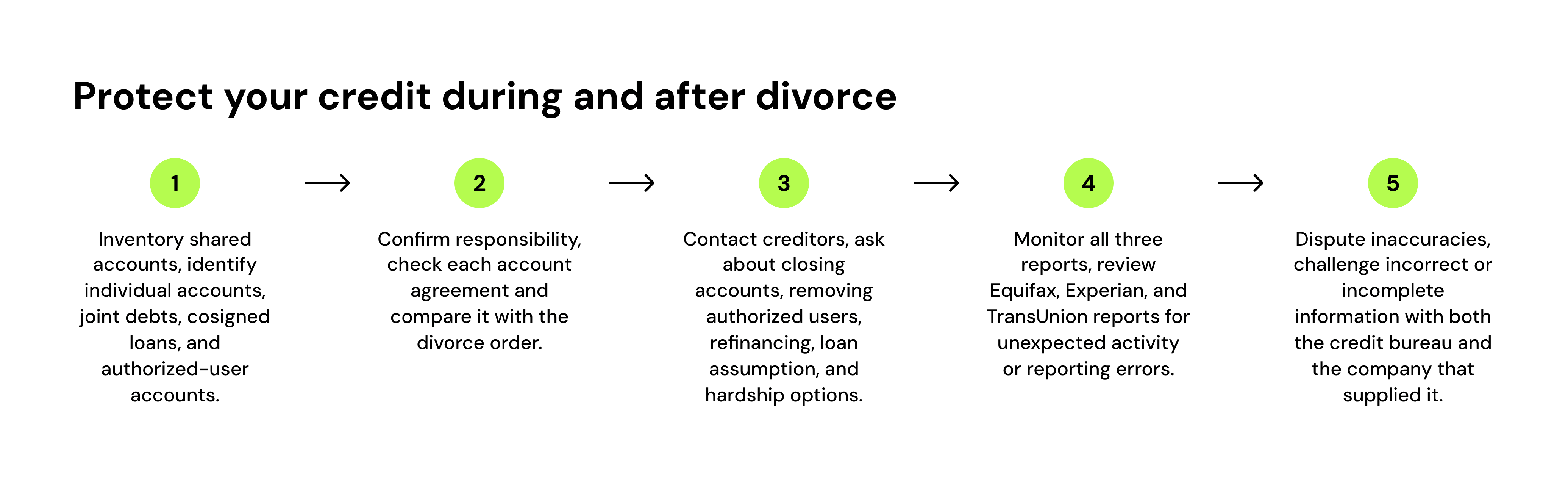
Review all shared accounts
Make a list of your joint credit cards, loans, bank accounts, utilities and other shared obligations. For each account, record:
- The names on the account.
- The current balance.
- The minimum payment and due date.
- Who can make new charges.
- Who the divorce agreement assigns the debt to.
- What the creditor requires to remove a borrower.
Check your credit reports for accounts you may have overlooked. You can review reports from all three nationwide credit bureaus as often as weekly through AnnualCreditReport.com. The CFPB also recommends reviewing your reports for unfamiliar accounts and reporting errors.
Close or separate joint accounts when appropriate
Contact each creditor to ask what options are available for a joint account. Depending on the creditor and account type, you may be able to:
- Stop new charges.
- Remove an authorized user.
- Close the account to future purchases.
- Transfer an eligible balance.
- Open separate accounts.
- Request that one account holder be released.
Closing an account may not eliminate the existing balance. Both joint account holders may remain responsible for repayment until the debt is paid or the creditor agrees to release one of them.
You can also review the steps for removing an ex-spouse from your credit report.
Refinance shared loans when possible
If one spouse is keeping a home or vehicle, refinancing the loan in that person’s name may remove the other spouse’s contractual responsibility. Refinancing depends on lender approval, income, credit and the value of the property, so it may not be available in every situation.
If refinancing isn’t possible, selling the property and paying off the loan may be another option. Because these decisions can affect your property rights, taxes and divorce agreement, speak with your attorney or another qualified professional before proceeding.
Keep making required payments
Continue monitoring any account that still includes your name, even if your divorce agreement assigns the debt to your former spouse. If a payment is missed, contact the creditor promptly to discuss the account and any available options.
Paying a debt that was assigned to your former spouse may involve legal and financial tradeoffs. Ask your attorney what remedies may be available under your divorce agreement rather than assuming reimbursement is guaranteed.
Dispute inaccurate information
A divorce doesn’t provide grounds for removing accurate account information. However, you have the right to dispute information that is incomplete or incorrect.
For example, you may have a valid dispute if:
- An account you never opened appears on your report.
- A payment you made on time is reported as late.
- A refinanced loan still incorrectly lists you as a borrower.
- An account continues to list you as an authorized user after the creditor removed you.
- The same debt is reported more than once.
The CFPB recommends disputing an error with both the credit bureau and the company that supplied the information. Include a clear explanation and copies of documents supporting your position.
Kikoff’s free AI Credit Disputes tool can also help you identify potential errors and prepare personalized dispute letters. A dispute may correct inaccurate information, but it can’t remove accurate negative information simply because it resulted from a divorce.
Bottom line
A divorce agreement doesn’t appear on your credit report or directly change your credit scores. The greater risk comes from joint debts, missed payments, changing credit limits and accounts that remain contractually connected after the divorce.
Review your credit reports, contact each creditor and confirm any account changes in writing. For questions about debt responsibility or enforcing your divorce agreement, consult a licensed attorney familiar with the laws in your state.
Financial independence often starts with credit in your own name. Kikoff’s Credit Account reports on-time payments to all three major credit bureaus, helping you build positive payment history without a hard credit check to sign up. Payment behavior and other credit activity can affect your credit, and individual results may vary.
Frequently Asked Questions
Article Sources
Disclaimer: The information provided in this blog post is meant for informational purposes only and does not constitute financial advice.