.jpg)
.jpg)



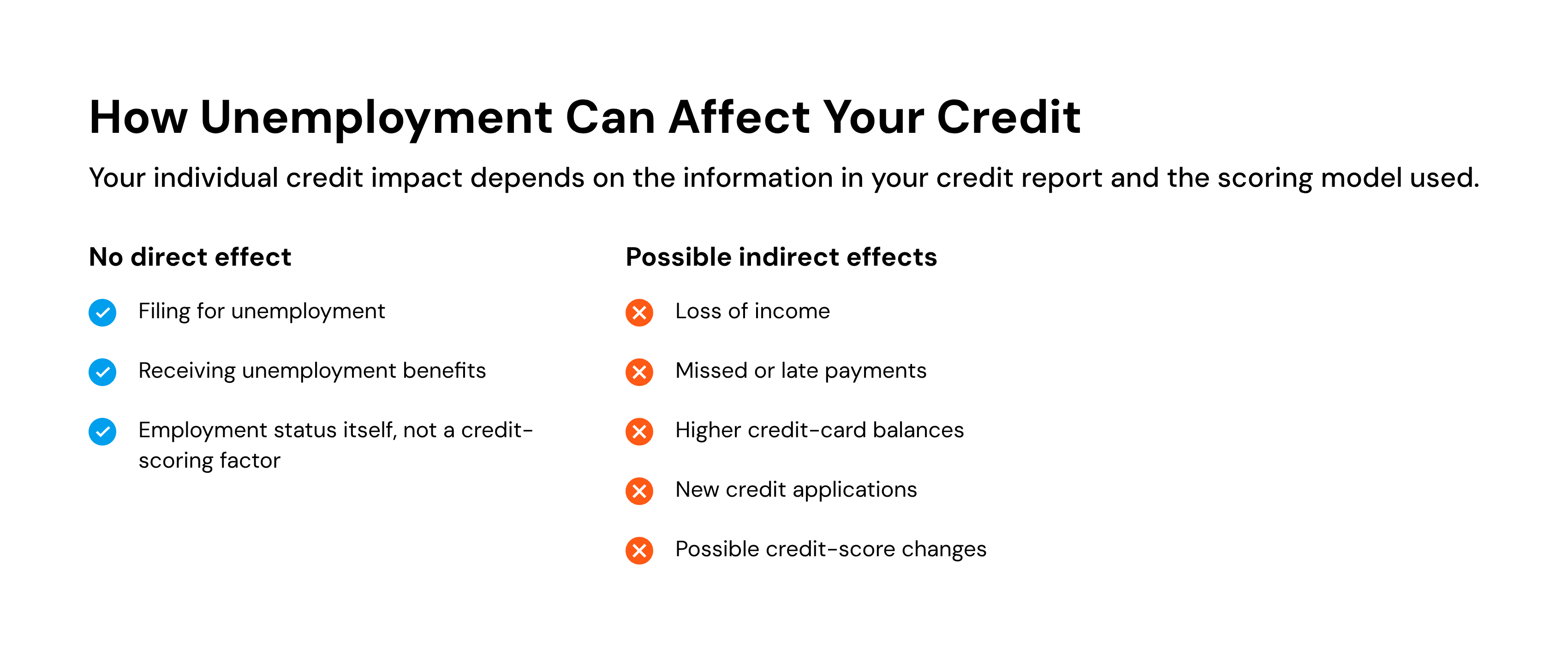
Losing a job is stressful, and it can leave you wondering what else might be affected. The good news is that filing for or receiving unemployment benefits does not directly affect your credit score.
Unemployment can affect your credit indirectly if the loss of income makes it harder to pay bills or leads you to rely more heavily on credit cards. Unemployment benefits may help you cover essential expenses and keep accounts current while you look for work.
Does filing for unemployment affect your credit score?
No. Filing for or receiving unemployment benefits does not appear on your credit report, according to Experian, and credit-scoring models do not consider whether you are employed.
A credit report may list the names of current or former employers provided on previous credit applications, but it does not show your employment status or unemployment benefits.
Instead, your credit score is generally based on information such as:
- Payment history
- Credit utilization
- Length of credit history
- Credit mix
- Recent credit applications
These are the five main factors used to calculate FICO Scores. Other scoring models may weigh information differently, but employment status and income are not credit-scoring factors.
Lenders may still ask about your income or employment when you apply for new credit. That information can affect whether you qualify for a particular account even though it does not directly affect your credit score.
How unemployment can indirectly affect your credit
Unemployment itself does not damage your credit. However, the resulting loss of income may lead to financial decisions that affect the information in your credit report.
Missed or late payments
Payment history generally carries more weight in FICO Scores than any other individual scoring category. A payment reported as late may lower your score, although the effect depends on your overall credit profile and how recent, frequent and severe the late payments are.
Most negative payment information can remain on a credit report for up to seven years. Its effect on your score may lessen over time, especially as you add more recent positive payment history.
If you think you may miss a payment, contact the creditor before the due date. Ask whether it offers a hardship plan, temporary payment reduction or another form of assistance.
Read more >> What Happens If You Miss a Credit Card Payment?
Increased credit utilization
Credit cards may help cover essential expenses during a temporary income gap, but growing balances can increase your credit utilization. Credit utilization is the percentage of your available revolving credit that you are currently using, and higher utilization may negatively affect your score.
For example, suppose you have a total credit limit of $10,000 and balances totaling $2,000. Your utilization is 20%.
If you add another $4,000 in charges, your total balance becomes $6,000 and your utilization rises to 60%. Even if you continue making payments on time, that higher balance may affect your credit score.
Avoid charging more than you can reasonably repay, and pay balances down when your budget allows.
Read more >> What Is Credit Utilization and How Does It Affect Your Credit Score?
New loans or credit cards
Borrowing money during unemployment may provide short-term relief, but it also creates another payment obligation at a time when your income is limited.
Applying for a loan or credit card commonly results in a hard inquiry. A hard inquiry may have a small, temporary effect on your credit score, although the effect varies by credit profile.
A new credit card can also increase your utilization if you quickly build a balance. Before applying, review the interest rate, fees and required payment, and consider how you will repay the debt if your unemployment lasts longer than expected.
How to protect your credit while unemployed
A period of unemployment may require difficult financial decisions. Focus first on protecting your basic needs, then take steps to prevent manageable accounts from becoming delinquent.
Prioritize essential expenses and required payments
Start with necessities such as housing, food, utilities, medication, insurance and transportation. After covering those expenses, try to make at least the minimum required payment on each credit account.
Paying only the minimum will not prevent interest from accumulating, but it can help keep an account current. If you cannot make a required payment without sacrificing an essential expense, contact the creditor as soon as possible instead of waiting for the account to become delinquent.
Ask creditors about hardship programs
Some lenders and credit card issuers offer assistance to customers experiencing a temporary loss of income. Depending on the creditor and your circumstances, available options may include:
- A reduced monthly payment
- Temporary forbearance
- Payment deferral
- A lower interest rate
- Waived fees
Before accepting an arrangement, ask how it will affect your account, whether interest or fees will continue and how the creditor will report the account to the credit bureaus. Get the agreement in writing when possible.
If you need help reviewing your options, the National Foundation for Credit Counseling can connect you with a nonprofit credit counselor. A counselor can help you review your budget and prioritize debts based on your circumstances.
Use credit cards carefully
If you need to use a credit card while you are between jobs, try to limit charges to essential expenses. Track your balance and available credit so you know how much of your limit you are using.
Avoid relying on a higher credit limit as a substitute for income. Any amount you charge will still need to be repaid, typically with interest if you cannot pay the statement balance in full.
Monitor your credit reports
Reviewing your credit reports can help you identify reported late payments, unfamiliar accounts and other potential errors. Checking your own reports does not affect your credit score.
You can request free online credit reports from Equifax, Experian and TransUnion as often as weekly through AnnualCreditReport.com, the federally authorized source for free credit reports.
If you find inaccurate information, you have the right to dispute it with the credit bureau and the company that supplied the information.
Bottom line
Losing a job or receiving unemployment benefits does not directly change your credit score. The credit risk comes from possible financial consequences, such as missed payments, growing card balances and new debt.
Prioritize essential expenses, contact creditors early and ask for help if you cannot keep up with your required payments. When your income is stable enough to comfortably manage another account, you can start building a positive credit history with Kikoff. Kikoff’s Credit Account reports your on-time payments to all three major credit bureaus, with no hard credit check to sign up.
Frequently Asked Questions
Article Sources
Disclaimer: The information provided in this blog post is meant for informational purposes only and does not constitute financial advice.