


.jpg)
.jpg)



Car loan forbearance does not automatically hurt your credit score. Its effect depends on whether you entered the agreement before missing payments, how the lender reports your account and whether you follow the agreement.
Auto lenders may call this type of assistance forbearance, deferment, a payment extension or a hardship plan. Whatever name your lender uses, get the terms in writing and ask how the arrangement will affect your credit reporting, interest charges and repayment schedule.
Does car loan forbearance hurt your credit score?
It depends on the terms of the agreement and how your lender reports the account.
If the lender approves an arrangement before your payment becomes delinquent and continues reporting the account as current, the agreement may not affect your score. However, lenders do not all report hardship arrangements in the same way.
Payments reported late before the agreement begins can still affect your credit. You could also face negative reporting if you miss a reduced payment, fail to resume payments on time or do not satisfy another requirement in the agreement.
Ask your lender these questions before accepting an offer:
- Will my account be reported as current during the relief period?
- Will the agreement or deferred-payment status appear on my credit reports?
- When does the arrangement begin and end?
- Do I need to make any partial payments?
- Will interest continue to accrue?
- Will I be charged a fee?
- How and when must I repay the skipped amount?
- Will my loan’s maturity date change?
Do not stop making payments until your lender confirms that the arrangement is active.
How car loan forbearance works
Car loan forbearance is a temporary agreement that changes what you are required to pay during a financial hardship. Depending on the lender, it may allow you to pause a payment, make a reduced payment or follow a temporary repayment schedule.
The Consumer Financial Protection Bureau recommends contacting your lender or servicer as soon as you know you may be unable to make a payment. Available options may include changing your due date, entering a payment plan or temporarily pausing payments.
Approval is not guaranteed. Your lender may consider your payment history, the reason for the hardship, how long you expect it to last and whether you can resume payments afterward.
Forbearance, deferment and payment extensions
Auto lenders do not always use these terms consistently. A program called “forbearance” by one lender may operate like a “deferment” or “payment extension” offered by another.
A common auto loan arrangement moves one or more payments to the end of the loan. Another arrangement may temporarily reduce or suspend payments and require you to repay the deferred amount separately.
The program’s name is less important than its written terms. Review what you must pay during the relief period, when regular payments resume and how the postponed amount will be collected.
Interest and fees during forbearance
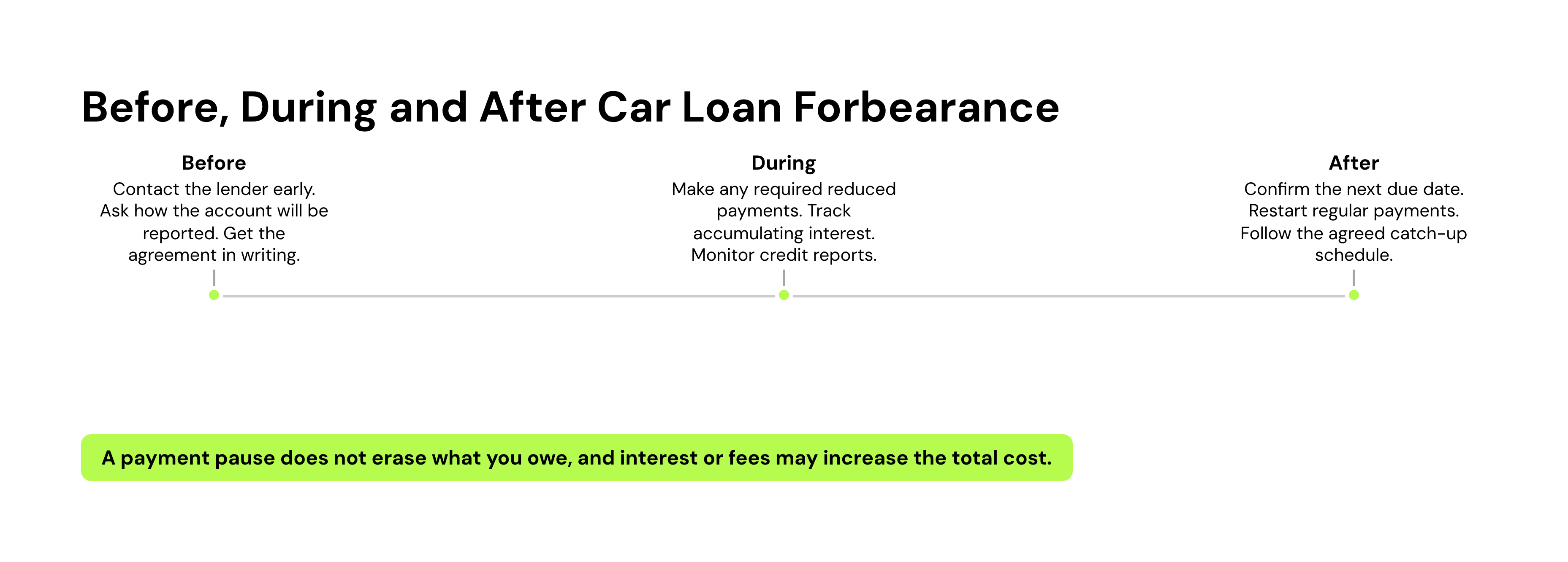
A payment pause does not erase the amount you owe. Interest commonly continues to accrue during an auto loan extension, increasing the loan’s total cost.
Your lender may also charge an extension or processing fee. Depending on the agreement, deferred payments could:
- Be added to the end of the loan
- Be divided among future payments
- Be due through a separate repayment plan
- Be required as a lump sum
- Extend the loan’s maturity date
Do not assume that your next payment will be the same as it was before the agreement. Ask for a schedule showing every required payment and the estimated additional interest and fees.
How forbearance may be reported to the credit bureaus
There is no single credit-reporting treatment that applies to every auto loan hardship program. Your lender may continue reporting the account as current, report a deferred-payment status or use another notation that reflects the agreement.
The notation itself may not affect your score, but the underlying payment status can. A payment reported 30 or more days late may become part of your payment history and affect your score.
If you were already behind before the arrangement started, an approved forbearance generally does not erase accurate late payments reported earlier. It may help prevent additional delinquencies only if the lender reports the account according to the new terms and you satisfy the agreement.
Keep the written agreement, confirmation number and copies of all correspondence. These records may help if the lender later reports the account differently from what it promised.
When car loan forbearance can affect your credit
Forbearance may affect your credit when:
- A payment becomes delinquent before the agreement takes effect
- The lender reports paused or reduced payments as late
- You miss a payment required under the agreement
- You do not resume regular payments by the specified date
- You cannot make a lump-sum or catch-up payment due afterward
- The lender reports inaccurate account information that you do not dispute
The score impact of a reported late payment depends on your overall credit profile, the scoring model and how recent and severe the delinquency is.
When forbearance may help protect your credit
Forbearance may help you avoid additional late payments if the lender approves it before you fall behind and reports the account according to the modified terms.
It may also give you time to address a temporary hardship without immediately losing access to your vehicle. That can be especially important when you rely on the car for work, school or medical care.
Forbearance is generally a short-term tool. If your income is unlikely to recover before the agreement ends, another option may be more sustainable.
What happens when car loan forbearance ends?
Your written agreement should explain the exact date on which regular payments resume and how the deferred amount will be repaid.
Before the relief period ends:
- Confirm your next payment amount and due date.
- Ask whether your automatic payments will restart.
- Review any interest or fees added during the arrangement.
- Confirm whether the loan’s maturity date changed.
- Make sure you can afford both the regular payment and any catch-up amount.
Contact the lender immediately if the required payment is different from the written agreement or if you still cannot afford it. Do not wait until the account becomes delinquent to discuss another solution.
Car loan forbearance alternatives
If forbearance does not fit your situation, your lender may offer another form of assistance.
| Option | How it may work | What to consider |
|---|---|---|
| Due-date change | Moves the monthly due date closer to when you receive income | Interest may change slightly because more time passes between payments |
| Temporary payment plan | Divides a past-due amount among upcoming payments | Your monthly obligation may be higher during the plan |
| Payment extension or deferment | Moves one or more payments to a later date | Interest and fees may increase the total cost |
| Loan modification | Changes one or more loan terms | A longer term may lower the payment but increase total interest |
| Refinancing | Replaces the existing loan with a new one | Approval is not guaranteed, and a longer term may cost more overall |
| Selling the vehicle | Uses the sale proceeds to pay the loan | You must compare the vehicle’s value with the loan payoff amount |
Before refinancing or modifying the loan, compare the total remaining cost rather than looking only at the new monthly payment.
If you cannot afford the vehicle over the longer term, consider speaking with a nonprofit credit counselor about your budget and available options. The National Foundation for Credit Counseling can connect you with nonprofit counseling.
Missing payments and repossession risk
Do not assume that you can miss several payments before the lender takes the vehicle. Your loan contract defines default, and state repossession laws vary.
According to the Federal Trade Commission, lenders in many states may be able to repossess a vehicle once the borrower defaults, sometimes without advance notice or a court order. A repossession may also leave you responsible for a deficiency balance if the lender sells the vehicle for less than you owe.
If you have received a repossession notice or believe the lender is violating an agreement, contact the lender immediately. Consider speaking with a licensed attorney or local legal-aid organization about the rights that apply in your state.
Read more: How Many Payments Can You Miss Before the Car Is Repossessed?
How to limit credit problems during forbearance
Contact the lender early
Reach out as soon as you know you may have trouble paying. Contacting the lender before the due date may give you more options and reduce the likelihood of a payment being reported late.
Get every term in writing
The agreement should identify:
- Its start and end dates
- Payments required during the relief period
- The date and amount of the first regular payment afterward
- Interest and fees that will continue
- How the deferred amount will be repaid
- How the lender intends to report the account
- Whether collection and repossession activity will pause
Save the agreement and all related messages until the loan is paid off and your credit reports reflect the correct history.
Monitor your credit reports
Review your credit reports to confirm that the lender is reporting the account consistently with the written agreement. You can request free online reports from Equifax, Experian and TransUnion as often as weekly through AnnualCreditReport.com.
Checking your own credit reports does not affect your score.
Dispute reporting errors
If the lender reports a payment late despite the written agreement, contact the lender first. You also have the right to dispute inaccurate information with the credit bureau and the company that supplied it.
Include a copy of the forbearance agreement, payment records and relevant correspondence with your dispute.
Protect the rest of your budget
Continue paying essential expenses and other accounts on time when possible. Avoid taking on unnecessary debt to compensate for the temporary payment pause.
If your budget cannot support the auto loan after the relief period, focus on finding a sustainable transportation and repayment plan rather than opening another account solely for credit-building purposes.
Bottom line
Car loan forbearance does not automatically affect your credit score. The outcome depends on the written agreement, the account’s status before the agreement, how the lender reports it and whether you make every required payment.
Contact the lender early, ask about interest and credit reporting, and get the complete arrangement in writing. If the account is reported incorrectly, use your documentation to dispute the error.
Once your hardship has passed and your budget is stable, you can focus on adding positive payment history. Kikoff’s Credit Account reports your on-time payments to all three major credit bureaus, with no hard credit check to sign up. Avoid adding a new account if its required payments would interfere with your car loan or essential expenses.
Frequently Asked Questions
Article Sources
Disclaimer: The information provided in this blog post is meant for informational purposes only and does not constitute financial advice.