


.jpg)
.jpg)



Most people who sign a lease have no intention of breaking it. However, job changes, financial hardship, military service, health concerns and other unexpected events can make moving before the lease ends necessary.
Breaking a lease does not usually appear on your credit reports or directly affect your credit scores. However, unpaid rent, termination fees or repair charges could be sent to collections and reported to the credit bureaus. A lease dispute may also appear in court records or tenant-screening reports, potentially making it harder to rent another home.
The amount you owe after ending a lease depends on the lease terms and applicable state and local laws. Before moving, review your agreement and document any arrangement you make with your landlord.
Does breaking a lease affect your credit?
The act of ending a lease early generally does not appear as a separate item on a standard credit report. Credit scores are calculated from information in your credit reports, such as your payment history, account balances and collection accounts.
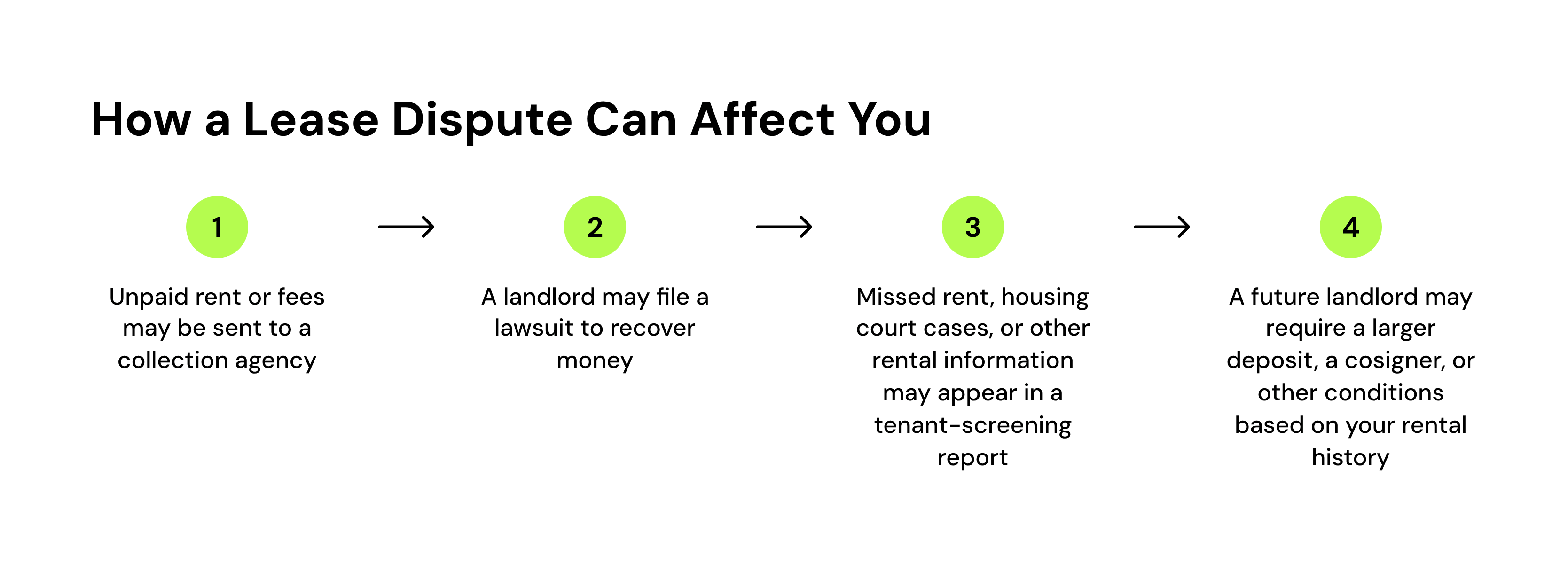
However, a lease dispute can affect you in other ways:
- Unpaid rent or fees may be sent to a collection agency.
- A landlord may file a lawsuit to recover money.
- Missed rent, housing court cases or other rental information may appear in a tenant-screening report.
- A future landlord may require a larger deposit, a cosigner or other conditions based on your rental history.
Credit reports and tenant-screening reports are not the same. According to the Consumer Financial Protection Bureau, tenant-screening reports may include rental history, eviction actions, lawsuits and a tenant risk score in addition to credit information.
How breaking a lease can lead to credit or rental problems
Unpaid rent or fees may be sent to collections
Depending on your lease and local law, you may be responsible for unpaid rent, an early termination charge, repairs beyond normal wear and tear or other costs.
If you do not pay an amount you legally owe, the landlord may refer the balance to a collection agency. A reported collection account may affect your credit, although its effect depends on the scoring model and the rest of your credit profile.
Do not assume that paying a collection automatically removes it from your credit reports. Before paying, verify that the balance is accurate, request the terms of any agreement in writing and keep proof of the payment.
A landlord may take legal action
A landlord may sue for unpaid rent, damages or other amounts claimed under the lease. A housing lawsuit or civil judgment generally does not appear as a traditional credit account, but the unpaid balance could later be sent to collections.
Court filings may also be available through public records or included in a tenant-screening report. Do not ignore a court notice, even if you believe the amount is incorrect. Consider contacting a tenant-rights attorney or finding a local legal-aid provider through the Legal Services Corporation.
The dispute may appear in a tenant-screening report
Tenant-screening companies collect information that landlords may use when reviewing rental applications. Depending on the report, this information may include missed rent, prior addresses, rental history and housing court cases.
If a landlord denies your application, charges a higher deposit or requires a cosigner because of a consumer report, the landlord must provide an adverse action notice. You can request a free copy of the report from the company identified in that notice within 60 days and dispute information that is incomplete or inaccurate. The Federal Trade Commission explains these tenant-screening rights.
Read more >> How Long Does an Eviction Stay on Your Record?
How to check whether a lease dispute has been reported
If you have already moved out or are concerned that a landlord reported a balance, check the records that could contain the information.
Review your credit reports
You can review your credit reports from Equifax, Experian and TransUnion online every week at AnnualCreditReport.com. Look for collection accounts connected to your former landlord, property manager or an unfamiliar collection company.
If you find inaccurate information, dispute it with the credit bureau and the company that supplied it. The CFPB provides instructions for disputing credit-report errors.
Request your tenant-screening report
If a prospective landlord took an adverse action based on a tenant-screening report, use the notice they provided to request your free copy. Review names, addresses, payment records, court cases and any information attributed to your rental history.
You can dispute errors with the tenant-screening company. In most cases, the company must investigate the dispute within 30 days.
Check relevant court records
If your former landlord threatened or filed a lawsuit, check with the court where the property is located. Court procedures differ by jurisdiction, so seek legal help if you do not understand a filing or believe a case was incorrectly attributed to you.
How to break a lease with fewer financial risks
Ending a lease early may still cost money, but taking the following steps can reduce the risk of unexpected charges and reporting problems.
Review your lease and local law
Look for clauses covering early termination, notice requirements, subletting, lease assignments and fees. State and local laws may limit what a landlord can charge or provide specific circumstances in which a tenant can end a lease early.
Some tenants may have additional legal protections. For example, qualifying servicemembers may be able to terminate a residential lease under the federal Servicemembers Civil Relief Act. Other protections, including those related to domestic violence or unsafe living conditions, depend on state and local law and may require specific documentation or notice.
Talk with your landlord before moving
Explain why you need to leave and ask whether the landlord will agree to an early termination arrangement. Possible options may include:
- Paying an agreed termination fee.
- Selecting a mutually acceptable move-out date.
- Arranging a payment plan for an outstanding balance.
- Finding a qualified replacement tenant.
- Subletting or assigning the lease, if permitted.
A replacement tenant does not automatically release you from your obligations. Confirm that the landlord approves the arrangement and releases you from further liability in writing.
Document the property’s condition
Before returning possession, take dated photos or videos of each room and any existing damage. Follow the lease’s cleaning and move-out requirements, return all keys and provide a forwarding address.
Documentation may help if the landlord later claims that you caused damage or failed to surrender the property properly.
Request an itemized final statement
Ask the landlord to provide an itemized account of any rent, fees, repairs or security-deposit deductions. Compare each charge with your lease and applicable law.
If you reach a settlement, request written confirmation of:
- The amount you agreed to pay.
- The payment deadline or schedule.
- Whether the payment resolves the full balance.
- Whether you have been released from future lease obligations.
Keep the lease, correspondence, payment receipts, move-out documentation and final statement together.
What to do if a landlord says you owe money
Do not ignore a balance simply because you disagree with it. Request an itemized explanation and compare the charges with your lease, move-out records and local tenant protections.
If the debt has been sent to a collection agency, verify that the amount and account information are accurate. Dispute incorrect information with the collection company and any consumer reporting agency displaying it. Accurate negative information generally cannot be removed merely because it is unfavorable.
If the amount is valid but you cannot pay it in full, ask whether the landlord or collector will accept a payment plan. Get any agreement in writing before sending money, and retain proof that you completed the payments.
Bottom line
Breaking a lease does not usually appear directly on your credit reports. The financial consequences can still affect your credit or future rental applications if unpaid charges go to collections or a dispute appears in court or tenant-screening records.
Review your lease, learn which state and local protections apply, communicate with your landlord and document every agreement. These steps can help you avoid misunderstandings and address legitimate obligations before they develop into larger problems.
If an inaccurate rental collection appears on your credit reports, Kikoff’s Credit Dispute tool can help you prepare a dispute letter. Once you’re making rent payments again, Kikoff Rent Reporting can report successful rent payments to Equifax and TransUnion each month.
Frequently Asked Questions
Article Sources
Disclaimer: The information provided in this blog post is meant for informational purposes only and does not constitute financial advice.