.jpg)



What’s the average American credit score? It might be higher than you think. Looking at credit score averages can grant you some insight into macroeconomic forces and consumer behavior, but it can also mask many of the nuances that shape credit scores. Take a closer look at the average American credit score by year.
Average American Credit Score by Year
| Year | Avg. FICO Score | Notes |
|---|
How credit scores are calculated and what the averages actually measure
When many people hear the term “credit score,” they imagine a singular number. However, depending on the credit scoring model used (FICO or VantageScore) and the credit bureau doing the calculation (Experian, Equifax, or TransUnion), one person’s credit score can vary significantly.
FICO vs. VantageScore and why the numbers differ
FICO and VantageScore are the two main credit scoring models. Both use data from your credit report, but they assign different weights to different factors.
Here’s how FICO scores are weighted[1]:
- Payment History: 35%
- Credit Utilization/Amounts Owed: 30%
- Length of Credit History: 15%
- Amount of New Credit: 10%
- Credit Mix: 10%
VantageScore uses a slightly more complex calculation with different weights:[2]
- Payment History: 40%
- Depth of Credit: 21%
- Credit Utilization: 20%
- Balances: 11%
- Recent Credit: 5%
- Available Credit: 3%
“Depth of credit” is a factor that combines the length of your credit history and the different types of credit you have. Lenders want to see that you can successfully manage different types of credit over a significant period of time, and this factor helps them accurately assess that.
Notably, when calculating your credit score, VantageScore doesn’t take paid collections into account.[2] FICO generally does.
Before releasing VantageScore 3.0 in 2013, VantageScore used a credit score range of 501 to 990. Standard FICO scores range from 300 to 850, so the mismatch caused confusion.
Now, FICO and VantageScore use the same score range, but they divide it into different “bands.” FICO lists five separate credit score categories, and VantageScore lists four. The FICO score ranges are:
- Exceptional: 800-850
- Very Good: 740-799
- Good: 670-739
- Fair: 580-669
- Poor: 300-579
And the VantageScore ranges are:
- Superprime: 780-850
- Prime: 661-780
- Near Prime: 601-660
- Subprime: 300-600
VantageScore has been growing in popularity for several years. However, FICO is still used in the vast majority of lending decisions.
When you view your credit report, you generally see three scores, one for each credit bureau. Those scores may differ slightly. Although many lenders report payments to all three credit bureaus, some only report to one or two. When assessing an application for credit, many lenders look for your middle FICO score.
Why national averages can mask meaningful variation
In the United States, the average FICO score was 713 in 2025.[3] The average credit score in America is solidly in the “good” range, so it’s easy to look at it and think that American consumers aren’t really having issues paying off their debts.
However, some economic experts say that the average score obscures an economic divide. Higher-income borrowers usually have enough funds to avoid major delinquencies, and over the past few years, their finances have generally improved.[4]
For low-income borrowers, the financial picture is very different. Inflation, increases in the cost of living, and wage stagnation have hit these consumers especially hard. For these borrowers, delinquencies are continuing to rise.[4]
National averages also hide the fact that average credit scores by age group vary considerably. Both FICO and VantageScore take the length of credit history into account, which means that with all else being equal, older people generally have higher credit scores.
It’s also important to remember that many Americans don’t use (or can’t access) mainstream credit. If they need to access funds in an emergency, these people often turn to payday loans, title loans, and other high-interest forms of alternative credit.
Average American credit score by year
Key economic events have shaped the average U.S. credit score history. However, FICO notes that credit scores are lagging economic indicators[5], meaning that it takes time for economic trends or events to be reflected in scores.
Notably, despite some minor fluctuations, Americans’ credit scores have generally trended upward.
Score trends from the early 2000s through the financial crisis
Right before the 2008 financial crisis, American credit scores were approaching 700. In October 2005, the average FICO score was 688. In April 2008, it was 690.[5]
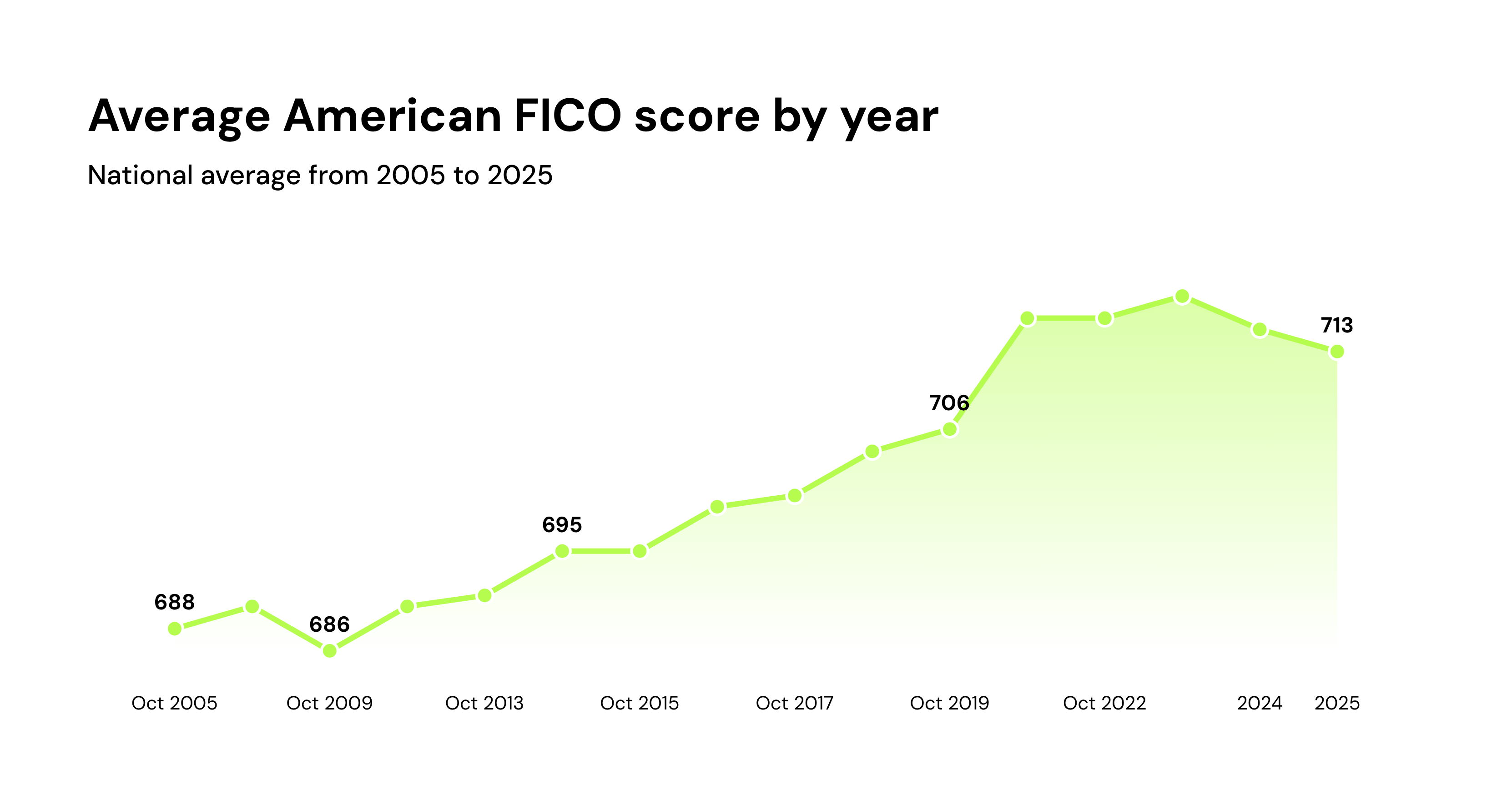
In the wake of the 2008 financial crisis, average scores dipped by four points, falling to 686 by October 2009.
The recovery and steady climb from 2010 through 2019
It took until April 2012 for average scores to climb back up to 690. But once they got there, Americans’ credit scores still continued to climb:[5]
- October 2013: 690
- October 2014: 694
- October 2015: 696
- October 2016: 699
- October 2017: 701
- October 2018: 705
- October 2019: 706
You might wonder why consumer credit scores have broadly continued to increase over time. Better consumer education is one possible explanation. One researcher noted that some consumers use deliberate strategies (like becoming an authorized user or increasing credit limits to lower overall utilization) to boost scores.[6]
It’s also important to keep in mind that delinquencies, bankruptcies, and other negative items don’t stay on credit reports forever. Most come off consumer credit reports after seven years,[7] and those consumers may see their scores increase dramatically as a result.
The COVID-19 pandemic and the unexpected rise in average scores
The COVID-19 pandemic was a time of significant economic turbulence. But for many Americans, it was also a time to improve credit. During the pandemic years, the portion of Americans with good credit or better increased. This wasn’t something seen during the 2008 recession.[8]
In April 2019, the average American FICO score was 706. By April 2021, it was 716, and that number held steady until October 2022. In April of 2023, it jumped up again, this time to 718.[5]
But what exactly drove the increase? Were more people with fair or poor credit improving their scores, or were fewer people with existing good credit damaging theirs? The Federal Reserve Bank of St. Louis discovered that it was a mixture of both.
From 2020 to early 2021, the “creation rate” (new “good” credit scores appearing) increased by 1.3 percentage points. The “destruction rate” (credit scores falling beneath the “good” threshold) decreased by 1.6 percentage points.[8]
Where average scores stand today
Given the post-pandemic economic turbulence that many Americans are still grappling with, you might be surprised to hear that the average American credit score by year is still relatively high. Consumer debt is also higher than ever. In fact, in the first quarter of 2026, it hit a record $18.8 trillion.[9]
Increases in consumer debt, high interest rates, inflation, and the surging cost of living are all beginning to take a toll on consumers. The average FICO score in the U.S. was 713 in 2025, which was a two-point drop from 2024. It was the first annual decline in the average score since 2013.[3]
What has driven score changes over time
Given the serious economic challenges of recent decades, it may seem like the average credit score should have fluctuated more dramatically.
However, behind each seemingly small drop in the average score are millions of households facing major financial issues. In some cases, the people who struggle the most aren’t captured in average credit score statistics.
The effect of the 2008 financial crisis on credit profiles
The 2008 financial crisis was primarily caused by mortgage lenders handing out large loans to unqualified buyers. So-called “NINJA loans” (no income, no job, no assets) required virtually no documentation from homebuyers.[10]
When many of these buyers defaulted, financial markets plunged into chaos around the globe. Subprime borrowers who defaulted and went through foreclosure saw extreme drops in their credit scores.
However, stricter lending standards after the crisis meant that lenders became far more cautious in who they lent money to. Income verification became common, and it was harder for subprime borrowers to find credit.
Denying credit to people who were statistically most likely to default helped increase average credit scores. However, it also meant that many who couldn’t access credit continued to struggle financially.
How the Credit CARD Act and post-crisis lending changes affected scores
The Credit Card Accountability Responsibility and Disclosure Act (CARD Act) of 2009 was passed to help curb unfair lending practices used by card issuers. It placed limits on many types of fees and created transparency around billing cycles.
However, it also introduced new rules that made it more challenging for subprime borrowers to access credit.[11]
The CARD Act prohibited lenders from abruptly raising interest rates, and it also placed caps on penalty fees. Generally, these are good things for cardholders. However, many issuers had previously used these tools to help offset the potential costs of lending to risky borrowers.
Predictably, while the new law didn’t have much of an effect on the total number of prime borrowers holding credit cards, it led to a drastic decrease in credit card ownership by nonprime and subprime borrowers.[12]
Because these people had trouble accessing credit going forward, many of their financial struggles weren’t reflected in the national average credit score.
Stimulus payments, reduced spending, and pandemic-era debt paydowns
Though many people increased their credit scores during the COVID-19 pandemic, there were a few reasons for this change.
Because many businesses were closed and many people stayed at home, spending decreased. Many consumers who received economic stimulus payments opted to use them to pay down debt, which lowered their credit utilization and increased scores.
Rising balances and delinquencies in the post-pandemic period
In the coming years, the country may very well see a continuing decline in average credit scores. As household debt continues to increase and incomes aren’t keeping up, an increasing number of borrowers have transitioned into serious delinquency (90 days late or more).
Here’s a look at the percentage of borrowers who transitioned into serious delinquency in the first quarter of 2025 compared to the first quarter of 2026:[13]
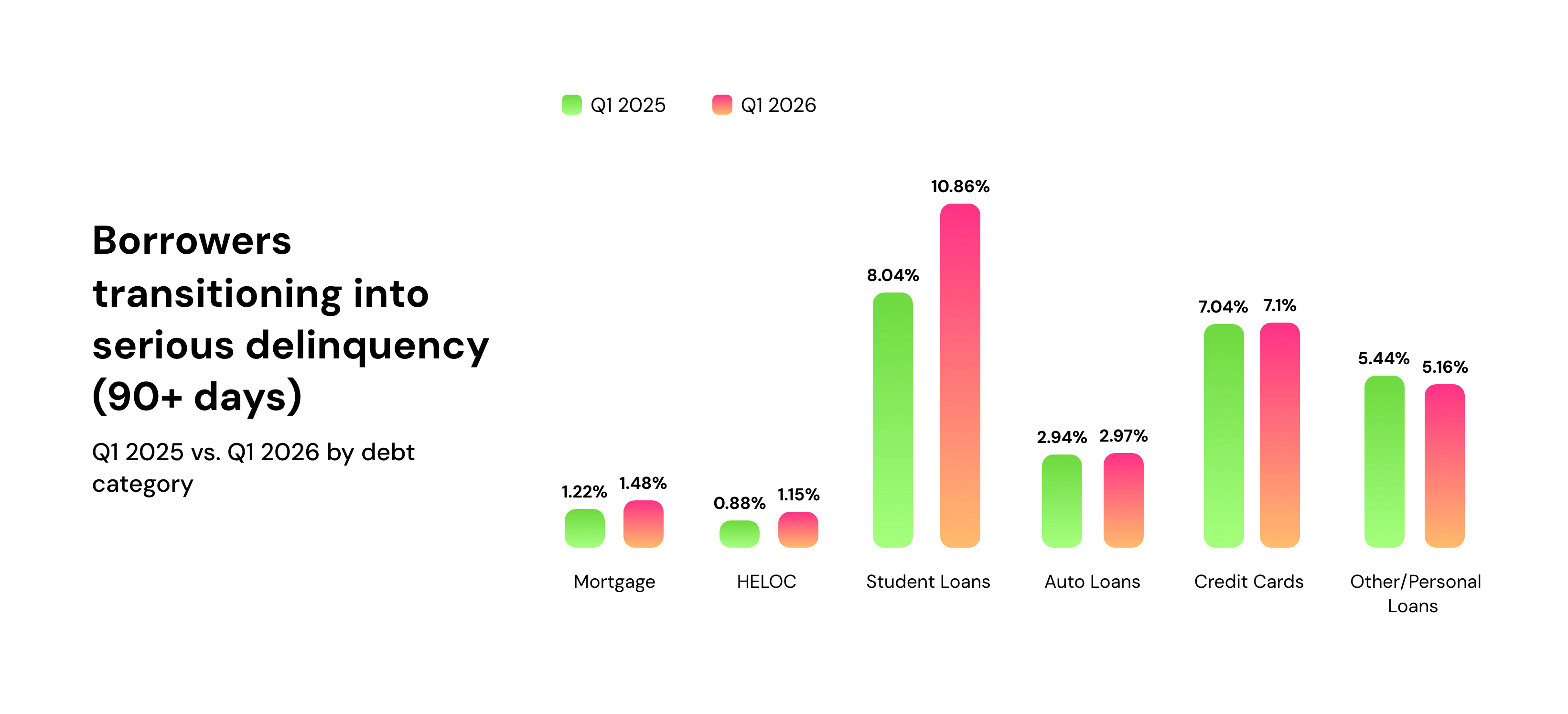
- Mortgage: 1.22% (Q1 2025) to 1.48% (Q1 2026)
- Home Equity Line of Credit: 0.88% (Q1 2025) to 1.15% (Q1 2026)
- Student Loans: 8.04% (Q1 2025) to 10.86% (Q1 2026)
- Auto Loans: 2.94% (Q1 2025) to 2.97% (Q1 2026)
- Credit Cards: 7.04% (Q1 2025) to 7.10% (Q1 2026)
Notably, the transition to serious delinquency for consumer debt in the “other” category (which includes personal loans) decreased from 5.44% in the first quarter of 2025 to 5.16% in the first quarter of 2026.
How average credit scores vary across Americans
The national average credit score can be a useful data point to have. But if you want to get a clearer picture of credit in America, it’s important to consider the ways that averages can vary based on age, location, race, and income level.
Scores by age and generation
Here’s a look at average FICO scores for 2025 for each generation:[3]
- Silent Generation (80+): 760
- Baby Boomers (61-79): 747
- Generation X (45-60): 709
- Millennials (29-44): 698
- Generation Z (18-28): 678
Most of the time, members of older generations have longer credit histories, which means they tend to have higher scores.
Scores by state and region
Average credit scores also vary by state or region. Generally, the northeast and the upper Midwest tend to have higher scores. In October 2025, these five states had the highest credit scores:[14]
- Minnesota: 742
- Vermont: 740
- Wisconsin: 739
- New Hampshire: 738
- Washington: 736
And these were the states with the lowest scores:
- Mississippi: 676
- Louisiana: 686
- Alabama: 691
- Georgia: 692
- Oklahoma: 695
Why do many southern states have lower credit scores? Some researchers suggest it’s because the region has some of the highest medical debt in the country. Many southern states haven’t expanded Medicaid, which makes it harder for lower-income residents to afford care.
Average incomes are also lower, which means that repaying debts can be more challenging.[15]
Scores by race
A 2024 report from Financial Health Network found the following average credit scores by race:[16]
- Asian: 774
- White: 729
- Hispanic: 702
- Black: 643
The report found that Asian and white consumers often had longer credit histories, which can help explain some of the disparities.
Scores by income level
The Consumer Financial Protection Bureau (CFPB) groups consumers into four income brackets based on their relationship to the country’s median income, which is currently around $80,000. Here’s how those brackets are determined:[17]
- Low Income: Less than 50% of median
- Moderate Income: 50% to less than 80% of median
- Middle Income: 80% to less than 120% of median
- Upper Income: 120% of median or more
And here are the median FICO scores for each group:[17]
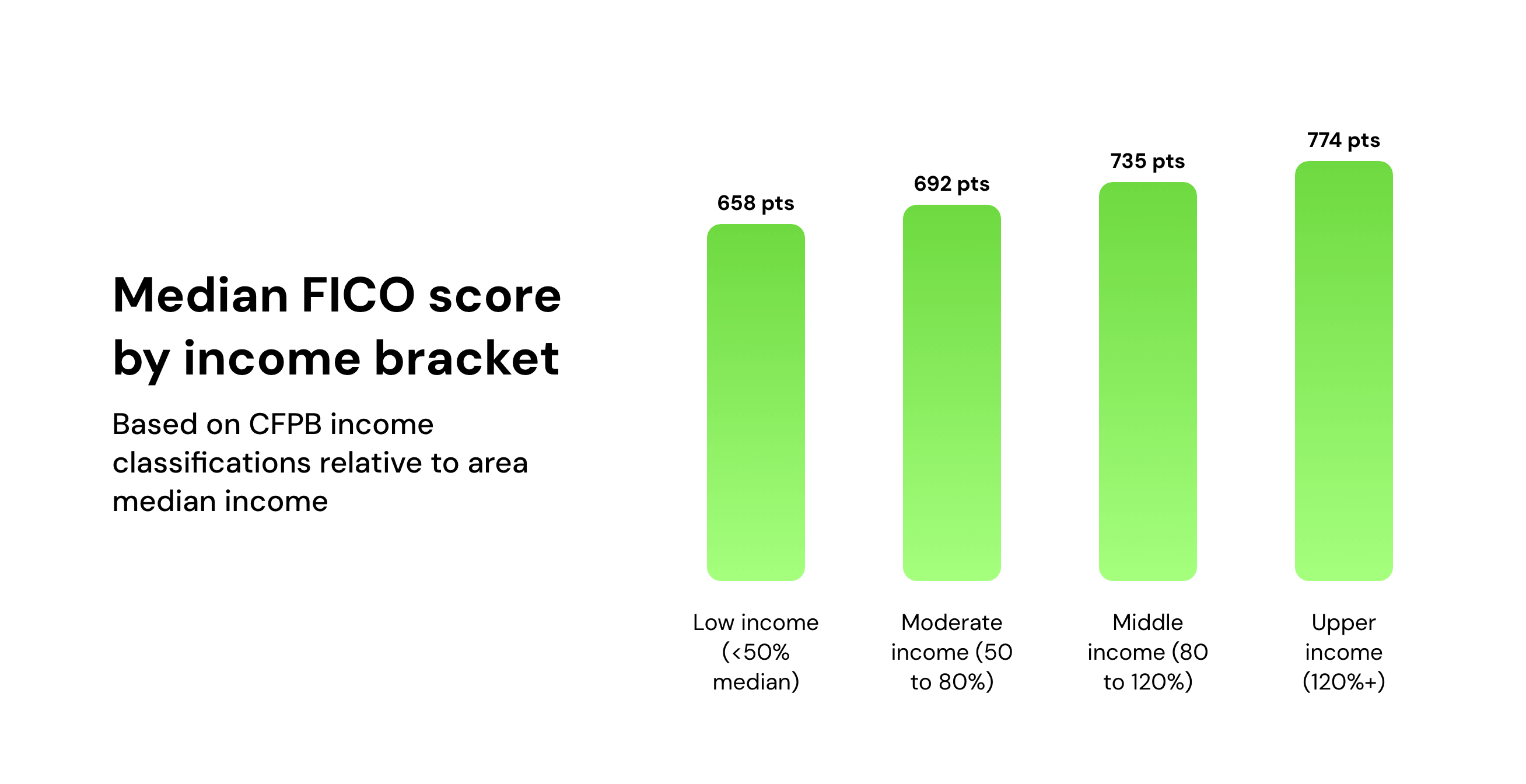
- Low Income: 658
- Moderate Income: 692
- Middle Income: 735
- Upper Income: 774
Your income doesn’t directly factor into your credit score. However, if you have a higher income, you’re less likely to have trouble affording payments on your mortgage, car loan, or credit card. Payment history is the most important factor when calculating your FICO score, so even one late payment can cause major damage.
The credit invisible and unscorable population
More than 45 million consumers in the United States don’t have a credit report or credit score.[18] For these people, accessing traditional credit can be extremely difficult. Although some do ultimately work toward building a credit file, others continue to rely on non-mainstream credit.
FAQ
Can someone with a low income have a good credit score?
Yes, absolutely. Although people with lower incomes tend to be at greater risk of default on credit accounts (because they tend to have lower cash reserves), income itself isn’t factored into score calculations.
Is my VantageScore or FICO score more important?
Because the majority of lenders use FICO when making decisions, your FICO score is generally more important. VantageScore is often found on free credit-monitoring platforms, and it’s still a useful way for you to track overall financial health.
How much does one missed payment impact your credit score?
Once a payment is 30 days late, it goes on your credit report and impacts your score. The higher your score was before the delinquency, the greater the decrease is likely to be. Score drops of 100 points or more are common, and your score could even fall by as much as 180 points.[19]
How can the average American credit score help you better understand your credit score?
Although it takes time for them to catch up to economic changes, average credit scores can offer you some insight into our general financial health. However, looking at averages alone doesn’t allow you to appreciate the unique struggles faced by lower-income or credit-invisible Americans.
When you understand what factors influence credit scores on both personal and macroeconomic levels, you’ll be better equipped to move forward on your own credit journey.
Frequently Asked Questions
About the editor

Article Sources
Disclaimer: The information provided in this blog post is meant for informational purposes only and does not constitute financial advice.